The school needs a court order. The doctor needs a court order. You need a plan.
You took this child in because nobody else would — or could. Maybe a parent entered rehab, maybe they went to jail, maybe they just vanished. Now the school will not enrol the child, the doctor will not treat them, and the benefits office wants legal proof that you are the one in charge.
Indiana gives relatives a legal path through guardianship and custody. But the process is scattered across Title 29, Title 31, county clerk offices, and a stack of forms that nobody explains. Court staff can check your paperwork for completeness — they cannot tell you which order to file, how to serve a parent in prison, or what the judge expects at the hearing.
The Indiana Court Process System
This is not a generic template or a form packet. It is a structured court process system built for Indiana relatives — grandparents, aunts, uncles, adult siblings and family friends — who need legal authority over a child and do not have a lawyer walking them through it.
The guide puts every step in order: which legal order fits your situation, the forms you file, who you notify and how, what happens at the hearing, and what the court expects after appointment. Where a form comes from Indiana Legal Help, the guide tells you exactly which one, what goes on each line, and what to ask the clerk before you file.
What the Guide Covers
- Order comparison table — Title 29 guardianship, Title 31 custody and standby declarations side by side, so you choose the right path before spending a filing fee
- Every form, every step — Verified Petition, consents, Application for Appointment, CHINS Disclosure (when a listed condition applies), Minor Guardianship Without Consent packet (CCA-GU-1120-4002), Notice of Hearing, Summons and fee waiver petition, with line-by-line guidance
- Notice and service tracker — certified mail, sheriff service, serving incarcerated parents, and service by publication when a parent cannot be found, with a log to prove compliance
- Background check walkthrough — who needs a criminal-history check, what the court reviews, and how prior DCS contact is disclosed
- Hearing preparation — what the judge typically asks, what evidence to bring, courtroom etiquette, and how to handle a parent who contests
- Emergency and temporary orders — the 90-day temporary guardianship under IC 29-3-3-4, standby declarations, and the process for converting a temporary order to permanent
- Post-appointment duties — estate inventory deadlines, biennial reports and accountings, Letters of Guardianship for school and medical enrolment, and how to modify or end the order
- County verification worksheet — local clerk contact, filing fee confirmation, e-filing vs. paper filing, and any county-specific forms your court requires
What Is in the Free Checklist
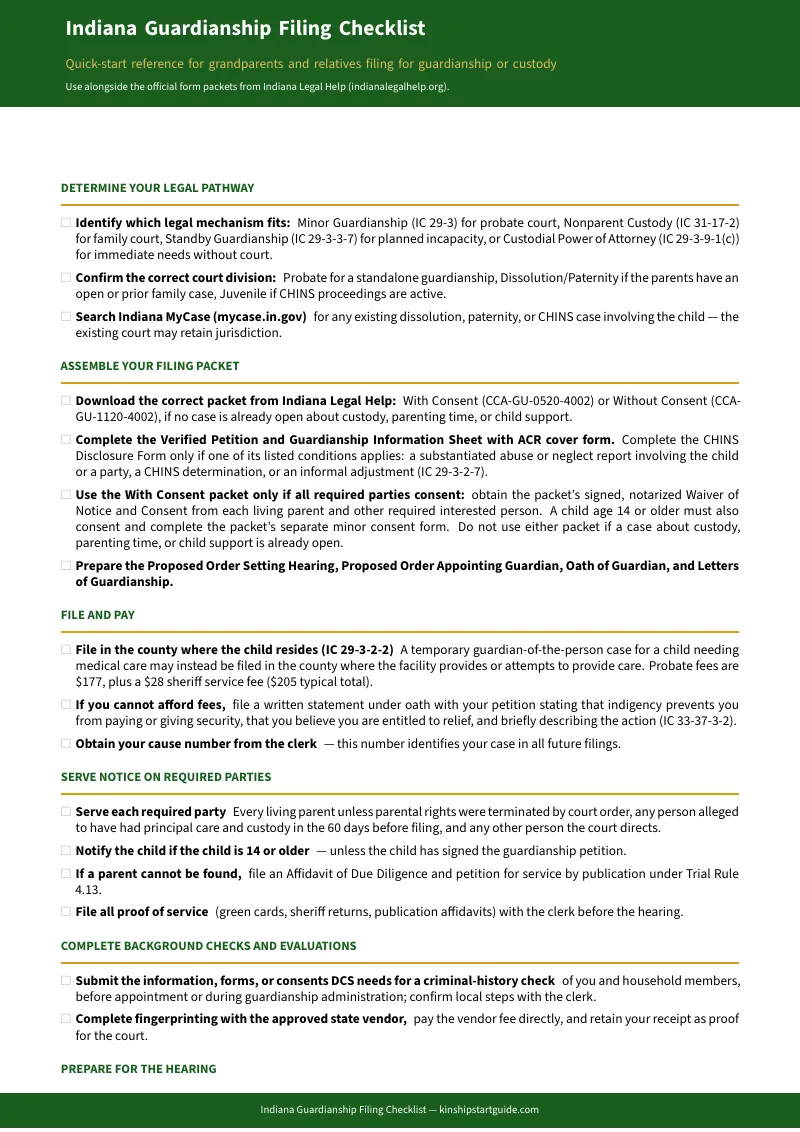
The free Indiana Guardianship Filing Checklist is a printable sheet with the filing sequence, clerk verification questions, statutory age milestones and fee waiver pointers. It is enough to see what the process looks like and start organising — and it is yours whether or not you get the full guide.
Who This Guide Is For
- Grandparents caring for a grandchild after a parent's addiction, incarceration, illness or death
- Aunts, uncles, adult siblings and family friends who took a child in with little or no notice
- Relatives who need school enrolment, medical consent or benefits access and are told they need a court order
- Caregivers comparing guardianship and custody to decide which path fits before filing
- Anyone with a DCS placement who wants to understand the formal guardianship process
Why Not Just Use the Free Forms?
Indiana Legal Help provides free form packets — and they are a legitimate starting point. The guide links to them. But the forms do not tell you which order to file, how to serve a parent you cannot locate, what to say at the hearing, or how to handle the CHINS disclosure when the child has a DCS history. They also do not cover the county-level differences in filing requirements, local cover sheets, or clerk practices that vary across Indiana's 92 counties.
Pro se filers who miss a notice requirement or serve the wrong form waste their filing fee and face months of delays. The guide is a process manual that puts the forms in context — so you file once, correctly.
What This Guide Is Not
This is not legal advice. It does not recommend whether to file for guardianship or custody, predict what a court will decide, or advise on the merits of a dispute with a parent. It explains the process step by step for people without a lawyer, and it tells you exactly when to seek legal counsel — contested cases, interstate jurisdiction issues, active CHINS litigation and immediate safety threats.
It is not affiliated with the Indiana Judicial Branch, the Department of Child Services or any court.
Full Refund, No Time Limit
If the guide is not what you need, email [email protected] for a full refund. No time limit, no questions.
Frequently Asked Questions
Do I need a lawyer to use this guide?
No. The guide is written for people filing without a lawyer. It walks you through every form and step. If your case becomes contested or involves interstate custody issues, the guide explains when to consult an attorney and where to find low-cost legal help in Indiana.
Which counties does this cover?
The guide covers the statewide process under Indiana Code Titles 29 and 31, plus a county verification worksheet you fill in with your local clerk's specific requirements. Indiana's 92 counties share the same statutes but differ on local forms, filing preferences and clerk practices — the worksheet catches those differences.
What if both parents are alive but one will not consent?
The guide covers both with-consent and without-consent guardianship. When a parent refuses consent, you must serve them formal notice and the court holds a hearing. The guide walks through the notice requirements, service options and what to expect at a contested hearing — though it does not advise on the merits of any dispute.
Is this the same as getting custody?
No. Guardianship (Title 29) and custody (Title 31) are different legal paths with different standards, different courts and different effects on parental rights. The guide compares both side by side and helps you understand which one fits your situation — without recommending one over the other.
Can I use this guide if a child was placed with me by DCS?
Yes. The guide explains how the formal guardianship process works whether DCS is involved or not. The CHINS Disclosure Form applies when the child has a substantiated abuse or neglect report, a CHINS determination, or an informal adjustment, or when a party was found to be a perpetrator in a substantiated report. It also explains the difference between private guardianship under Title 29 and the KinGAP subsidised guardianship available to eligible children who are DCS or JDJS wards.
How quickly can I get legal authority?
A temporary emergency guardianship can be granted the same day in urgent cases. A permanent guardianship typically takes several weeks to several months, depending on whether parents consent, how quickly service is completed and your county's hearing schedule. The guide maps out realistic timelines for each path.
Frequently Asked Questions
What if the rules change after I buy?
We update the guide when the rules change. Email us any time, even years later, and we'll send you the current edition free.