The school says "bring a custody order." The clinic says "we need the parent." Neither is telling you the full picture.
A child landed in your home because a parent couldn't be there — addiction, incarceration, illness, deployment, or just gone. Within days you needed to enroll that child in school and take them to a doctor. The school registrar asked for a custody order you don't have. The pediatric clinic said they need a biological parent to sign. You left both offices without an answer, and the child still needs to start class on Monday and see a dentist before the pain gets worse.
Here's what neither office told you: the District of Columbia has specific legal instruments — the OSSE Other Primary Caregiver framework for school enrollment and D.C. Code § 16-4901 for medical consent — that give relatives decision-making authority without going to court. The official forms are free. But they are scattered across different agency websites, the instructions assume you already understand how they work together, and no one at the front desk is trained to explain what you need.
The DC Caregiver Consent Navigator
This guide is a single-document process-navigation system for getting a child into school and into the doctor's office when you are the grandparent or relative — not the parent, and not a court-appointed guardian. It takes the forms, statutes, and agency rules that are spread across OSSE, DC Health, CFSA, and the DC Superior Court, and puts them in the order you actually need them: who qualifies, which form to use, what supporting documents to bring, and what to say when a clerk or receptionist still says no.
It covers the full landscape of authority options a DC relative caregiver has: the OSSE Other Primary Caregiver status (with all eight recognized hardship categories and the five supporting-document pathways), the medical consent authorization under § 16-4901 (including the statutory sample form and the flexibility to use any qualifying written authorization), standby guardianship under § 16-4801, the minor's own consent rights, and the point at which a court petition for custody or guardianship becomes the better route.
What's inside the guide
- Authority comparison matrix — OSSE OPC status, D.C. Code § 16-4901 medical consent, standby guardianship under § 16-4801, and formal Family Court custody compared side by side: who qualifies, how long each lasts, what each one authorizes, and when each path makes sense
- OSSE OPC enrollment walkthrough — the complete Other Primary Caregiver form process for DCPS and public charter schools, including the five supporting-document options (sworn statement, school records, medical records, benefit documentation, or professional attestation), the eight recognized hardship categories, and the separate DC Residency Verification requirement
- Professional attestation guide — how to get a doctor, social worker, or legal professional to sign the OSSE OPC Attestation Form when a parent is unavailable, what qualifies a professional to attest, and the restriction that school officials and LEA employees cannot serve as attestors
- Medical and dental consent under § 16-4901 — how a parent, legal guardian, or legal custodian delegates consent for medical, dental, developmental screening, mental health, and immunizations, the statutory sample form, the flexibility to use any qualifying written authorization, revocation rules, and how to present the document at a clinic that has never seen it
- Standby guardianship under § 16-4801 — the triggering events (incapacity, death, adverse immigration action), the 90-day automatic-authority window, the court petition required to extend authority beyond 90 days, and how standby guardianship differs from the Probate Division's GDN estate guardianship
- Minor's own consent rights — when a DC minor can consent independently to pregnancy-related care, substance abuse treatment, mental health services, and STI treatment under DCMR Title 22-B §§ 600–602, plus the Medicaid primary-care consent provisions for minors 16 and older under D.C. Law 25-145
- Special education and Section 504 rights — how IDEA's broad "parent" definition applies to relative caregivers, requesting evaluations, authority for IEP and 504 meetings, and the Early Stages Process (ESP) for young children in the District
- Financial subsidy programs — the Grandparent Caregivers Program, the Close Relative Caregivers Program, TANF child-only grants, SNAP, and Medicaid coverage, with application steps and the TANF-first application requirement
- Desk-counter checklists and scripts — printable sheets for the school registration desk and the clinic reception desk, with polite escalation language and the statutory citations that resolve most refusals on the spot
- Refusal and escalation log — a structured template for recording dates, facility names, staff contacts, and the specific reason cited when a school or clinic refuses your paperwork, plus direct escalation contacts for OSSE, Legal Aid DC, and the Children's Law Center
- 12-month expiration tracker — a printable calendar to track OPC attestation expiry dates, § 16-4901 authorization renewal, and other document deadlines so nothing lapses mid-year
- Court petition decision tree — when informal consent authority is enough and when it's time to file for custody or guardianship in the DC Superior Court Family Court, with pointers to the Self-Help Center and free legal representation
- DC contact directory — direct numbers and links for Legal Aid DC, Children's Law Center, CFSA Kinship Navigator (kinshipdc.org), DC Bar Pro Bono Center, the Family Court Self-Help Center, OSSE enrollment support, and the DC Healthcare Alliance
Who this is for
- Grandparents, aunts, uncles, adult siblings, and family friends in DC who have suddenly taken in a child and need to get that child enrolled in school and to the doctor — now
- Relatives who tried to register a child at a DCPS school or charter school and were told they need a custody order they don't have
- Caregivers who need a pediatrician, dentist, or mental health provider to accept their authority to consent to treatment for a child in their care
- Social workers, community advocates, and out-of-area relatives buying a clear, printable resource on behalf of someone who needs step-by-step instructions
Why not just download the free government forms?
You should download the free government forms. OSSE publishes the OPC Form and the OPC Attestation Form for free on osse.dc.gov, and D.C. Code § 16-4901 includes a suggested sample medical consent authorization. This guide links to every official resource.
But those forms are blank templates on separate government websites. They don't explain which path fits your situation, what supporting documents you need for OPC verification, whether you can enroll a child when the parent refuses to sign, or what to say when a school clerk looks at your paperwork and still demands a court order. National form sites sell generic "Minor Power of Attorney" templates that may not comply with DC's specific OPC and § 16-4901 requirements. This guide fills the gap between having the forms and knowing how to use them at the counter.
What this guide does not do
This is an independent process-navigation guide — not a government publication, not a legal service, and not connected to any court, school, or agency. It does not provide legal advice, recommend a custody outcome, or take sides in any family dispute. For legal questions specific to your situation, contact Legal Aid DC, the Children's Law Center, or the DC Superior Court Family Court Self-Help Center — all free.
Full refund, no time limit
If the guide does not help your situation, email [email protected] for an immediate refund. No deadline, no questions.
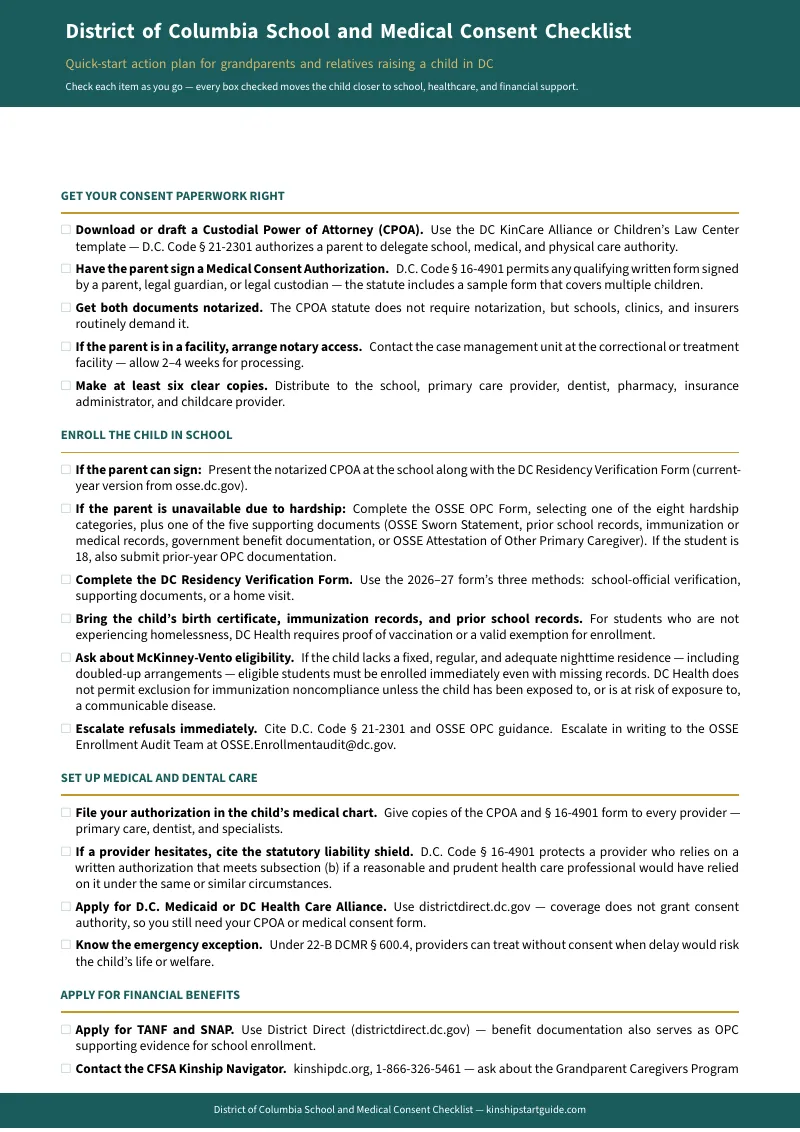
The free checklist gives you the highlights — the consent forms to know about, the enrollment steps, and the agencies to call. The full kit gives you the complete system: a 49-page guide, plus 8 standalone printable worksheets and tools — the authority comparison matrix, desk-counter scripts, school enrollment worksheet, medical consent worksheet, 12-month expiration tracker, refusal log, court decision tree, and benefits application tracker.
Frequently Asked Questions
What if the rules change after I buy?
We update the guide when the rules change. Email us any time, even years later, and we'll send you the current edition free.