The school wants a court order. The clinic wants custody papers. Delaware law says you need neither — if you file the right affidavit.
You took in a child — maybe your grandchild, a niece, a nephew, or the child of a close relative who can't be there right now. The reasons are painful and private, and you didn't have weeks to prepare. What you had was overnight.
Now the child needs to start school. Needs a doctor's appointment. Needs a dentist. And every front desk you walk up to asks for paperwork that sounds like it requires a lawyer, a judge, or a parent who isn't available.
Here's what most caregivers don't know: Delaware has a Dual-Affidavit Authorization System — one statutory affidavit for school under 14 Del. C. § 202(f), and a separate one for medical care under 13 Del. C. § 708. Together they let a qualifying relative handle enrollment, routine educational decisions, pediatric checkups, dental care, immunizations, and emergency treatment without going to court. But you have to use both correctly. Submitting the school affidavit to a medical office, or the medical affidavit to a school registrar, will get you turned away. And each form has its own evidence requirements, notarization rules, and expiration dates.
What the Dual-Affidavit Authorization System Covers
The guide walks you through every consent tool Delaware recognises for a caregiver without a court order, and shows you exactly when to use each one:
- 14 Del. C. § 202(f) School Authorization Affidavit — the school enrollment document. Step-by-step completion instructions, the two-column evidence system (one relationship proof, one caregiving proof, or district-approved alternatives), notarization requirements, what to do when the parent is unavailable or uncooperative, the August 1 expiration and annual renewal, and the enrollment route when verification documents cannot be obtained
- 13 Del. C. § 708 Medical Authorization Affidavit — the medical consent document. Execution instructions, the exact clinical scope under § 707(a)(2) (routine medical, dental, preventive care, immunizations, and emergency treatment), the statutory exclusions, the one-year term and early-termination triggers, and the documented-search process for when a parent can't be reached
- School enrollment across all three counties — what New Castle, Kent, and Sussex County districts require at the registration desk, what they cannot demand, and the specific evidence pairings that satisfy the two-column system in practice
- Special education and McKinney-Vento — your authority to participate in IEP meetings under IDEA and 14 DE Admin Code 922, and when the child qualifies for immediate enrollment without standard documentation under McKinney-Vento
- Adolescent consent boundaries — the 16 Del. C. § 5003(f)(3) rule that allows teens aged 14 and older to consent independently to voluntary outpatient mental health treatment, and the separate requirement for parental or custodian consent on psychotropic medication
- Power of attorney and Family Court transition — when the affidavits aren't enough, the guardianship petition process under 13 Del. C. Chapter 23, and the red flags that signal you need a court order sooner rather than later
When the School or Clinic Says No
School registrars across Delaware routinely demand court orders or guardianship papers that no statute requires for enrollment. Pediatric offices refuse to see a child without "custody documentation" that the Code doesn't mandate. These refusals aren't malicious — they come from risk-averse institutional training and unfamiliarity with the relative caregiver statutes. But they stand between a child and the care that child needs right now.
The download includes ready-to-print escalation letters — citing the exact Delaware Code sections, the administrative code provisions, and the specific statutory language that covers your situation — that you can hand to a reluctant registrar or clinic manager. The guide also explains the 14 Del. C. § 202(f)(4) appeal to your local board of education for school enrollment disputes, and when to contact the Delaware ADRC, CLASI, or Delaware Volunteer Legal Services for further support.
The Two-Column Proof System That Trips Up Most Caregivers
Delaware's school affidavit requires two distinct forms of documentation: Column A (proof of relationship — a birth certificate, insurance policy, or similar document showing the family link) and Column B (proof of caregiving — a medical record, professional letter, or similar document confirming you are the child's day-to-day caregiver). Bring the wrong combination and the district registrar sends you home. Bring no documentation at all and the statute provides a narrow enrollment route — but only if you file a custody or guardianship petition within 10 business days.
The guide includes a Document Readiness Worksheet that lists every accepted combination for both columns, explains which alternatives districts may approve on a case-by-case basis, and walks you through what to prepare before you stand in that line.
The Affidavit Comparison Table
Should you use the school affidavit, the medical affidavit, a power of attorney, or a Family Court guardianship petition? The guide includes a comparison table that lays out who qualifies, what each document authorises, who needs to sign, how long it lasts, and when the simpler option stops being enough. Most caregivers discover they can handle school and medical care without a courtroom. Some learn they need the court sooner than they thought. Either way, you stop guessing.
Who This Is For
- A grandparent, aunt, uncle, or older sibling who has taken in a child and needs to get that child into school and to the doctor — this week
- A caregiver who tried to enrol a child and was turned away because they didn't have a court order — and wants to know whether that refusal was correct
- A relative who doesn't know whether the school affidavit, the medical affidavit, a power of attorney, or a guardianship petition is the right path for their situation
- A family helper or adult child buying this on behalf of an older relative who needs clear, step-by-step instructions they can print and follow
Why Not Free Resources?
The Delaware ADRC helpline (1-800-223-9074) is free, DSAAPD publishes the affidavit forms, and CLASI and Delaware Volunteer Legal Services provide legal aid for qualifying families. The guide links directly to all of them. It doesn't replace any of that — it bridges the gap between knowing those resources exist and knowing what to do when you're standing at a school registration desk right now.
Free resources give you raw PDF forms without step-by-step completion instructions. They don't include the Document Readiness Worksheet that ensures you bring the right proof pairings. They don't tell you what to say when a registrar demands guardianship papers that no statute requires. And they don't walk you through the adolescent mental health consent rules, the McKinney-Vento protections, the special education authority, the DFS intersection, the court transition decision matrix, the insurance and benefit options, or the escalation protocols that turn a rejected affidavit into an enrolled child.
What You Get
- The complete guide — 13 chapters covering both affidavits step by step, school enrollment across all three counties, the two-column evidence system, special education and IEP authority, McKinney-Vento protections, medical consent scope and exclusions, adolescent mental health consent, prescriptions and pharmacy logistics, health insurance (Medicaid, CHIP, marketplace), notarization and special situations (incarcerated parent, parent in treatment, deceased parent), DFS safety plans, the Family Court transition, ICWA, passports, DMV and teen licensing, worksheets, and a full resource directory
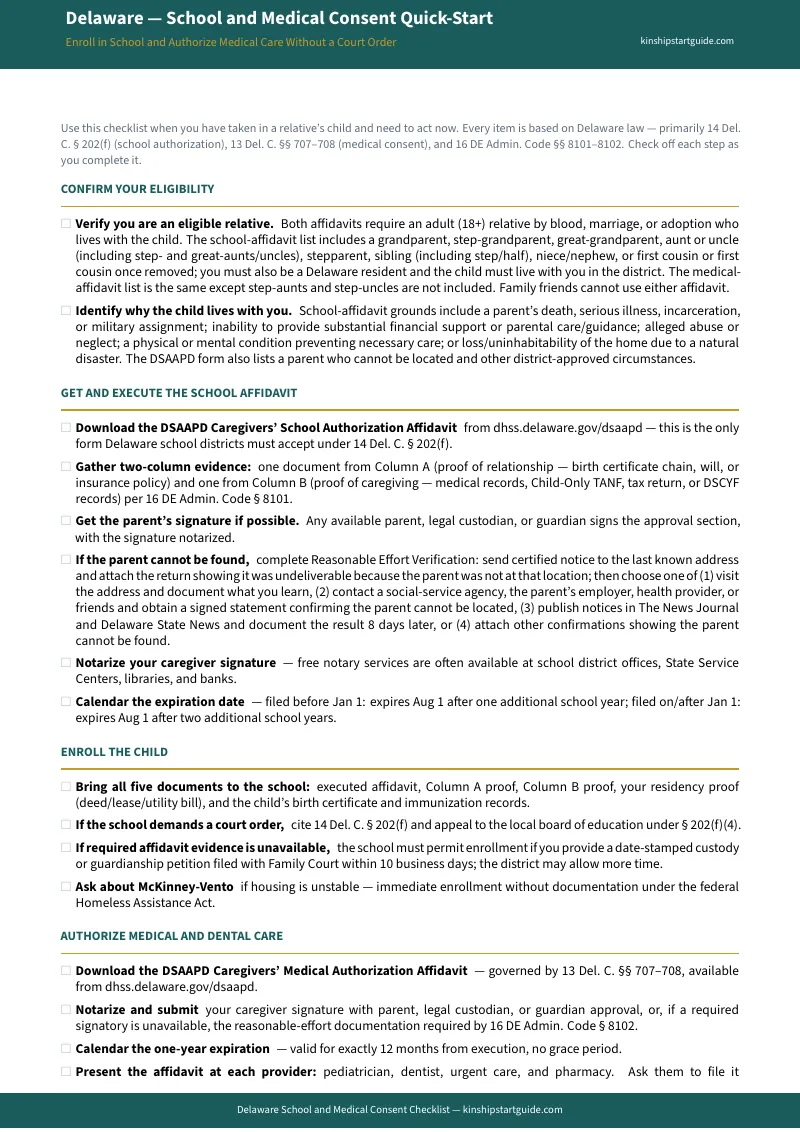
- The quick-start checklist — a printable summary of the forms, enrollment documents, and contact numbers you need in the first 72 hours
- Document Readiness Worksheet — the two-column proof pairings for the school affidavit with checkboxes for obtained, expiration, and storage location
- School Enrollment Preparation Checklist — every document to bring to the district office, with the statutory basis for each and what to do if an item is missing
- Medical Intake Preparation Worksheet — what to bring to the child's first paediatrician, dentist, or specialist appointment, plus a consent block for when a parent cannot be reached
- School and medical escalation letters — ready-to-print letters citing the Delaware Code sections and administrative code provisions that apply when an institution refuses your paperwork
- Affidavit Comparison Table — school affidavit vs. medical affidavit vs. power of attorney vs. Family Court guardianship, with eligibility, authority, signing requirements, and duration
- Administrative Refusal Log — dated landscape log of every school, clinic, or office that refuses your documents — names, reasons, and follow-up actions
- Agency Communication Log — landscape log of every school, clinic, DFS, and benefits conversation — date, person, what was discussed, what was decided, and follow-up
- Emergency contact and key information card — wallet and backpack cut-out cards with the child's name, allergies, insurance, and affidavit execution dates
Satisfaction Guarantee
Full refund, no time limit. If the guide doesn't help you navigate your situation, email [email protected] and we'll refund every penny — no forms, no waiting period, no questions.
A Child Shouldn't Wait for a Court Date to See a Doctor
Delaware's affidavit system exists so they don't have to. The guide shows you how to use it — every form, every deadline, every conversation — so the paperwork never stands between a child and the care that child needs.
Download includes the full 13-chapter guide, the quick-start checklist, and standalone printables (document readiness worksheet, school enrollment preparation checklist, medical intake preparation worksheet, escalation letters, affidavit comparison table, refusal log, agency communication log, and emergency cards). Instant access after purchase.
Already have the free checklist? The full kit goes deeper — step-by-step affidavit completion, the Document Readiness Worksheet that protects your proof at the registrar's desk, escalation letters for reluctant institutions, the court transition decision matrix, insurance and benefits eligibility, and the scenario walkthroughs that turn "I think this is right" into "I know exactly what to do."
Frequently Asked Questions
What if the rules change after I buy?
We update the guide when the rules change. Email us any time, even years later, and we'll send you the current edition free.