
The registrar wants a custody order. The pediatrician wants "legal paperwork." Connecticut law says you need the right form — not a courtroom.
You took in a child — a grandchild, a niece, a nephew, the child of a close friend who is somewhere they cannot parent right now. The reasons are painful and private. What matters today is that the child needs to start school, needs to see a doctor, and every office you walk into wants documents you don't have.
Here's the problem: Connecticut is not California. There is no single caregiver affidavit you can fill out at the kitchen table and hand to a school clerk. Generic forms sold online under a "Connecticut" label get rejected because Connecticut law does not recognise them. But Connecticut does have a Consent Authority System — a set of voluntary and court-based instruments, each granting a different level of authority over school enrollment, medical care, dental treatment, and educational records. The guide maps every instrument to every situation, so you know which form to use, who needs to sign it, what it lets you do, and when you've outgrown it.
What the Consent Authority System Covers
The guide walks you through each legal pathway Connecticut recognises for a caregiver without a court order:
- Parental Authorization Letter — when a parent is available and willing to delegate. Line-by-line instructions for drafting a legally valid letter that specifies school enrollment, medical consent, and dental care. The guide covers the execution requirements (written, signed by the parent, witnessed by two disinterested adults, notarized) and what to include so a school or clinic doesn't reject it for vagueness
- Standby Guardian Designation (CGS § 45a-624) — the statutory tool for a parent entering treatment, facing incapacity, or deploying. Full authority activates upon the triggering event and lasts up to one year. The guide explains the five execution elements, what counts as a triggering event, and when this path is stronger than a letter but weaker than a court order
- School Enrollment under CGS § 10-186 — the statute that entitles a child to attend public school in the district where they actually live, regardless of custody status. The guide covers the four residency conditions, what districts can and cannot demand, district-specific host statements and residency affidavits, and the 10-day Board of Education hearing appeal when a registrar says no
- Probate Court Petitions (Forms PC-504, PC-502, PC-501, PC-500, PC-508) — when a parent cannot or will not sign. The guide walks through each form: temporary guardian, temporary custody, emergency ex parte custody, removal of guardian, and guardianship when both parents are deceased. Filing requirements, attachments (JD-FM-164, confidential information sheets, birth certificates), and the fee waiver form (PC-184) for low-income petitioners
- Medical and dental consent tiers — what each authority level lets you authorise (routine visits, immunisations, dental, specialist referrals, prescriptions, surgery) and where caregiver consent hits its legal ceiling
- Adolescent mental health under CGS § 19a-14c — how Connecticut law lets minors consent to outpatient therapy independently when five statutory conditions are met, the six-session limit before review, the strict exclusion of psychiatric medication, and what this means for your access to the child's therapy records
When the School or Clinic Says No
School registrars across Connecticut routinely default to demanding custody papers the law does not require. Suburban districts demand notarized host statements with language that varies town by town. Urban districts funnel every kinship family through central registration offices that sometimes confuse CGS § 10-186 residency rights with guardianship proceedings. Pediatric offices refuse to schedule routine appointments for a child brought in by a grandparent with "only" an authorisation letter.
The guide includes an Enrollment Denial Tracking Log and a step-by-step escalation process — from demanding a written denial, to filing a 10-day Board of Education hearing request, to appealing to the Connecticut State Department of Education. For medical refusals, you get a clinic escalation pathway: Practice Manager, Patient Advocate, Office of Legal Risk Management. You document every interaction in writing, and that paper trail triggers the institutional accountability mechanisms built into Connecticut law.
The Authority-by-Instrument Comparison Matrix
Should you use a parental authorization letter, a Standby Guardian designation, a Probate Court temporary guardianship, or a full custody transfer? The guide includes a comparison matrix that lays out what each instrument authorises (school, medical, dental, mental health, educational records, travel), who needs to sign, how long it lasts, whether a parent can revoke it, and when you've outgrown it. Most caregivers discover the voluntary path is enough. Some learn they need Probate Court sooner than they thought. Either way, you stop guessing.
Who This Is For
- A grandparent, aunt, uncle, or older sibling who has taken in a child and needs to get that child into school and to the doctor — this week
- A caregiver who was turned away by a school registrar and told they need "custody papers" — and wants to know whether that's actually true under CGS § 10-186
- A family helper or adult child buying this on behalf of an older relative who needs clear, printable instructions they can bring to the school office
- Anyone navigating a situation where a parent is in a correctional facility, in treatment, or simply unreachable — and needs to understand the Probate Court path without paying $150–$500 for a document preparation service
Why Not Free Resources?
The Probate Court forms are free on ctprobate.gov, and we link directly to every one. Statewide Legal Services, 2-1-1 Connecticut, and the DCF Kinship Navigator programme offer essential help. The guide doesn't replace any of that — it bridges the gap between finding a form and knowing what to do with it.
Free resources give you blank court forms. They don't tell you which form fits your situation, what attachments each one requires, how to get a parent's signature when that parent is in a correctional facility, or what to say when a school registrar in Woodbridge demands a notarized host statement the statute doesn't mention. The official CSDE enrollment guidance is a policy document written for school boards, not for a grandparent who just had a child arrive at midnight. The guide translates the statute, the forms, and the institutional expectations into plain-language steps you can follow this week.
What You Get
- The complete guide — 10 chapters covering every consent pathway, school enrollment under CGS § 10-186, medical consent tiers, Probate Court forms (PC-504, PC-502, PC-501, PC-500, PC-508), adolescent mental health under CGS § 19a-14c, McKinney-Vento protections, IDEA educational parent rights, HUSKY Health and TFA benefits, and the court path decision framework
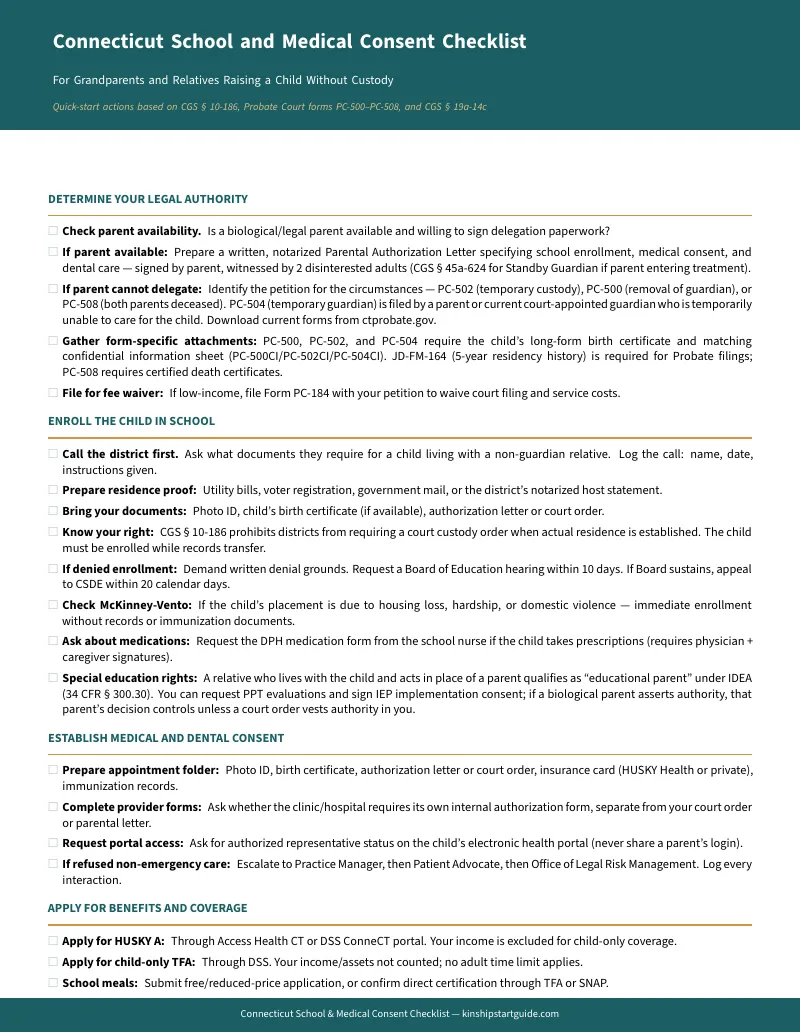
- The quick-start checklist — a printable 25-item summary of the forms, enrollment documents, benefit applications, and emergency contact numbers you need in the first week
- Seven printable planning tools — an authority decision flowchart, an authority-by-instrument comparison matrix, a school enrollment document checklist, a medical appointment readiness checklist, an enrollment denial tracking log, an agency communication log, and a benefits application tracker
Satisfaction Guarantee
Full refund, no time limit. If the guide doesn't help you navigate your situation, email [email protected] and we'll refund every penny — no forms, no waiting period, no questions.
A Child Shouldn't Wait for a Court Date to See a Doctor
Connecticut built a system so they don't have to — but the system is scattered across five Probate Court forms, a statute most registrars misread, and a set of voluntary instruments that nobody explains in one place. The guide puts it all in order.
Download includes the full guide, the quick-start checklist, and seven printable planning tools. Instant access after purchase.
Already have the free checklist? The full guide goes deeper — the complete authority-by-instrument matrix, the Probate Court filing walkthrough with every form and attachment listed, worked examples for common situations, the medical and school escalation pathways, the adolescent mental health consent rules, and seven printable planning tools (decision flowchart, enrollment and medical checklists, denial and communication logs, benefits tracker) that turn "I think this might work" into "I know exactly which form to bring."
Frequently Asked Questions
What if the rules change after I buy?
We update the guide when the rules change. Email us any time, even years later, and we'll send you the current edition free.