
You're paying for everything out of your own pocket. Connecticut has programs that pay for the child — but nobody gave you the list.
A grandchild arrived. Or a niece, a nephew, the child of someone who cannot parent right now. The reasons are painful. What matters today is that you're buying groceries, diapers, school clothes, and co-pays on a budget that was already tight — and the money you're spending is money the child may be entitled to in their own right, through programs you were never told about.
Here's what makes Connecticut different: the state's largest cash program for kinship families, the Temporary Family Assistance child-only grant, does not count your income. Not your Social Security. Not your pension. Not your wages. The eligibility determination runs on the child alone. But the DSS intake process doesn't volunteer that fact. Caregivers walk into an office, hear that their household income is "too high," and walk out believing they don't qualify — when the child-only pathway was available the entire time. The guide is a Connecticut Benefits Navigator — a single document that maps every program to every caregiving arrangement, so you never leave money on the table because an intake worker asked the wrong question.
What the Benefits Navigator Covers
The guide walks you through every financial program a grandparent or relative caregiver in Connecticut can access for a child in their care:
- TFA Child-Only Cash Grant — the program most caregivers don't know about. Your income and assets are excluded entirely. Only the child's own income counts. No time limit, no work requirement, no court order needed. The guide covers the application (ConneCT portal, Form W-1E, in-person at DSS Resource Centers), the interview, what documents to bring, and what to say if an intake worker mistakenly asks for your tax returns
- DCF Subsidized Transfer of Guardianship (STOG) — monthly stipends matched to foster care board rates for children who were formally in DCF custody and placed with a licensed relative foster home. The guide explains the six-month residency requirement, the permanency ruling, age-based per diem rates, medical complexity tiers, and continuation to age 21 for youth in education or training
- HUSKY Health (Medicaid) — comprehensive medical, dental, and behavioural health coverage for the child. Nearly every child in kinship care qualifies based on the child's income alone. The guide covers HUSKY A enrollment, what's covered, and how to add the child without disrupting your own coverage
- SNAP Food Benefits — household-based eligibility that works differently from TFA. The guide explains who counts in the household, what happens when a grandparent's income pushes the household over the limit, and the elderly/disabled food preparation exceptions that can change the calculation
- WIC and Free School Meals — nutritional support programs the child may qualify for independently. The guide covers categorical eligibility through TFA and Medicaid, the school meals application, and the Community Eligibility Provision that makes some districts free for all students
- Care 4 Kids Childcare Subsidies — subsidised childcare for working caregivers, including the pathway where a relative living outside the child's household can be paid as the child's provider. Requirements: at least age 20, Provider Orientation Program, background checks, maximum three children. The guide covers the income cap, sliding-scale co-payments, and the application process through the Office of Early Childhood
- Title III-E Respite and Emergency Grants — flexible funds through Connecticut's five Area Agencies on Aging for caregivers aged 55 and older. Annual respite grants reimburse camperships, daycare, or temporary care. Emergency grants cover rent, utilities, furniture, or food. The guide lists each AAA's service area, contact information, and application windows
- Probate Court Kinship Funds — court-administered assistance available through some Probate districts for kinship families navigating guardianship. The guide explains eligibility and how to ask
How Your Legal Arrangement Changes Everything
The money available to a kinship family in Connecticut depends heavily on how the caregiving arrangement is structured — and most caregivers don't realise that until they've already been denied benefits they could have received.
An informal caregiver (no court order, no DCF involvement) can access TFA child-only, HUSKY Health, SNAP, WIC, school meals, and Care 4 Kids. A Probate Court guardian adds the court's institutional backing for documentation, which simplifies applications and renewals. A licensed relative foster parent through DCF unlocks the highest-value program: Subsidized Transfer of Guardianship, where monthly stipends can exceed depending on the child's age and needs. The guide maps every program to every arrangement so you know exactly what you're eligible for right now — and what changes if your legal status changes later.
Who This Is For
- A grandparent, aunt, uncle, or older sibling who has taken in a child and is paying for everything — food, clothes, medical co-pays, school supplies — without financial support
- A caregiver on a fixed income who was told at the DSS office that they earn too much, and wants to know whether the child-only pathway applies
- A relative who just received a DCF placement and needs to understand what subsidies come with it and how to apply
- A family helper or adult child buying this on behalf of an older relative who needs clear, printable application instructions they can bring to each agency
- Anyone who tried to find the programs online and got lost between DSS, DCF, OEC, the Area Agencies on Aging, and the Probate Courts — and wants one document that connects everything
Why Not Free Resources?
The programs themselves are free. The DSS application is free. The ConneCT portal is free. 2-1-1 Connecticut, CTLawHelp.org, and the Kinship Navigator helpline are essential services, and the guide links directly to every one. It doesn't replace any of that — it bridges the gap between knowing a program exists and knowing how to get through the application without leaving money behind.
Free resources describe each program in isolation. They don't tell you which programs use only the child's income and which ones count your household, why an informal arrangement qualifies you for six programs but not the seventh, what to bring to a DSS interview for TFA child-only versus a DCF subsidy review, or what to say when an intake worker conflates the child-only grant with standard family assistance. The guide puts every program, every agency, and every application in the order a caregiver actually needs them — one document, one read, no tab-hopping between six state websites.
What You Get
- The complete guide — 14 chapters covering TFA child-only cash, DCF subsidised guardianship, HUSKY Health, SNAP, WIC, school meals, Care 4 Kids, Title III-E respite grants, Probate Court kinship funds, application walkthroughs, renewals, appeals, and how legal arrangements affect eligibility
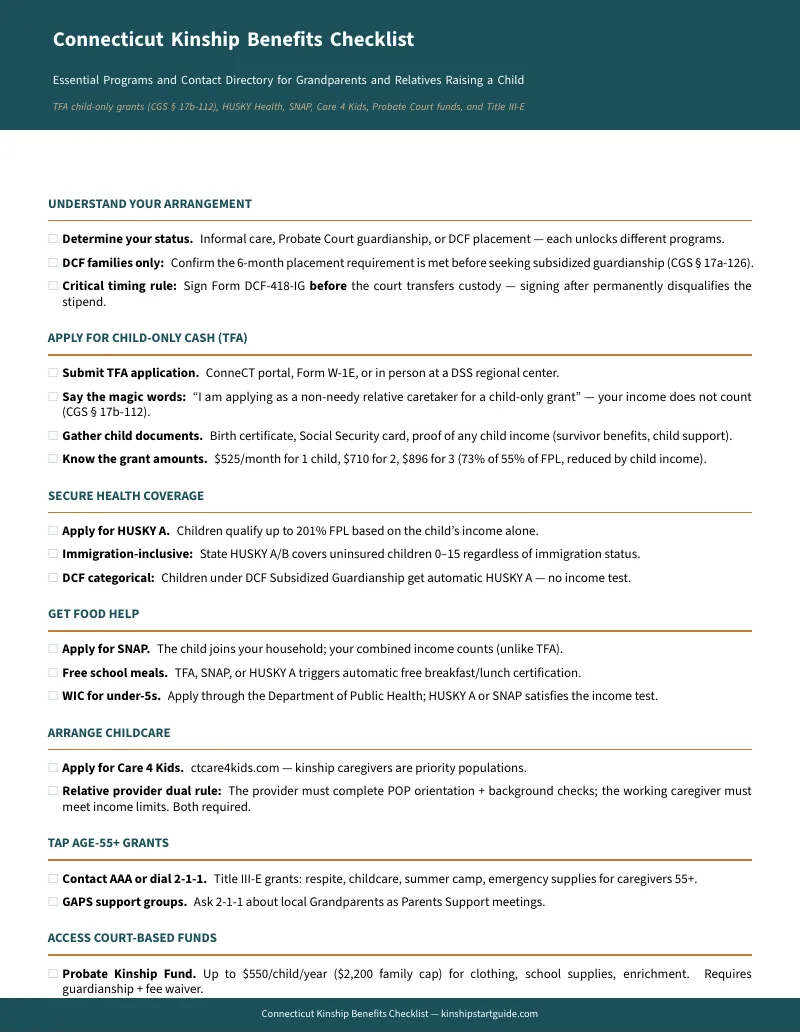
- The quick-start checklist — a printable summary of every program, the agency that runs it, and the documents to bring, designed to sit on the kitchen table as a to-do list
- 7 printable planning tools — agency routing map, document checklist, application tracker, benefit renewal tracker, agency communication log, interview preparation sheet, and hearing preparation worksheet
Satisfaction Guarantee
Full refund, no time limit. If the guide doesn't help you navigate your situation, email [email protected] and we'll refund every penny — no forms, no waiting period, no questions.
The Child Is Entitled to Help. You Shouldn't Have to Figure Out the System Alone.
Connecticut built a safety net for children being raised by relatives — but the pieces are scattered across five agencies, three court systems, and a portal that assumes you already know which program to search for. The guide puts every program, every application, and every dollar in one place.
Download includes the full guide, the quick-start checklist, and 7 printable planning tools. Instant access after purchase.
Already have the free checklist? The full guide goes deeper — the complete program-by-program eligibility breakdown, application walkthroughs with every document listed, interview preparation for DSS and DCF, the legal-arrangement comparison showing exactly which programs each status unlocks, denial and appeal instructions, renewal deadlines, and 7 printable tools (agency routing map, document checklist, application tracker, renewal tracker, communication log, interview prep sheet, hearing worksheet) that turn "I think the child qualifies" into "I know what to bring and what to say."
Frequently Asked Questions
What if the rules change after I buy?
We update the guide when the rules change. Email us any time, even years later, and we'll send you the current edition free.