You Have the Child. The School Wants a Court Order.
The child is already living with you. You're feeding them, getting them to school, taking them to the doctor. But somewhere along the way, an enrollment clerk, a nurse at the pediatrician's office, or a county benefits worker asked the question you've been dreading: "Do you have legal authority?"
Without a court order or a parent's valid delegation of power, you may lack authority to consent to medical care or enroll the child in school. Some informal kinship caregivers may qualify for child-only TANF and Medicaid even without legal authority for the student; each program has its own eligibility rules. The parent is unavailable — in treatment, incarcerated, unreachable, or gone — and you're stuck in a gap between doing everything and being authorized to do anything.
The Colorado Court Process Navigator
This guide is a structured, printable roadmap through Colorado's two main court-based legal paths for relatives: minor guardianship under Title 15 and allocation of parental responsibilities (APR) under Title 14. It takes the scattered forms, statutes, and courthouse procedures and puts them in the order you actually need them — from deciding which path fits your situation to filing your annual report after the judge signs the order.
It's built for people doing this without a lawyer. Plain language, numbered steps, and a printed checklist you can take to the courthouse.
What's Inside
- Guardianship vs. custody decision framework — the standing rules, court divisions, and practical trade-offs for each path, so you file in the right place the first time instead of discovering six weeks later that you needed a different court
- Complete form sequences for both paths — JDF 824 for guardianship, JDF 1031 for other nonparent APR applicants, and JDF 1703 for grandparents, plus the companion documents most self-represented filers don't know about (JDF 805 Acceptance of Office, JDF 705 Probate Case Information Sheet, CBI background check, credit report)
- Fee waiver walkthrough (JDF 205) — the income thresholds, the documentation you need, and how to submit the motion so the filing fee doesn't stop your case before it starts
- Notice and service for every scenario — consenting parent, uncooperative parent, parent in a Colorado correctional facility, parent who can't be found (including service by publication via JDF 716)
- Emergency and temporary guardianship — the difference between a 60-day emergency order and a 6-month temporary guardianship, when each applies, and the separate forms for each
- Hearing day preparation — what to bring, what the judge asks, how to organize an exhibit binder, and what to check with the clerk if your district permits remote attendance
- Post-order compliance — annual guardian reports (JDF 834), address change notifications, how to modify or terminate an order, and what happens when the child turns 18
- Denver Probate Court specifics — Denver handles guardianship in its own dedicated Probate Court, not the District Court; the guide covers the differences so Denver-area filers don't waste time at the wrong window
Who This Is For
This guide is for grandparents, aunts, uncles, older siblings, and close family friends in Colorado who are already caring for a child and need a court order to make it official. It's especially useful if:
- A school, doctor, or county office has asked for legal documentation of your authority
- The parent is absent, in treatment, incarcerated, or has died
- You're unsure whether guardianship or custody is the right filing for your situation
- You plan to file on your own and want to avoid procedural mistakes that delay the process
It is not for contested cases where a parent has an attorney and is actively fighting the petition. If that's your situation, the guide recommends consulting Colorado Legal Services or a family law attorney — and it explains how to prepare for that consultation efficiently.
Why Free Resources Aren't Enough
Colorado's Judicial Branch posts every form you need at no cost, and the courthouse self-help coordinators ("Sherlocks") can explain procedures and check your paperwork for completeness. Those resources are real and valuable.
What they can't do is tell you which path to file under, build your filing sequence, walk you through the background check and credit report requirements for the Acceptance of Office, or prepare you for what happens at the hearing. The forms arrive as isolated PDFs. The instructions assume you already know the difference between Title 15 and Title 14, between a probate docket and a domestic relations docket, between an emergency order and a temporary order.
This guide organizes all of it — forms, fees, notice rules, hearing logistics, and post-order duties — into a single document you can print and follow step by step.
What You Get
Your download includes 7 PDFs:
- The full guide (51 pages) — the complete court process from choosing your path through post-order compliance
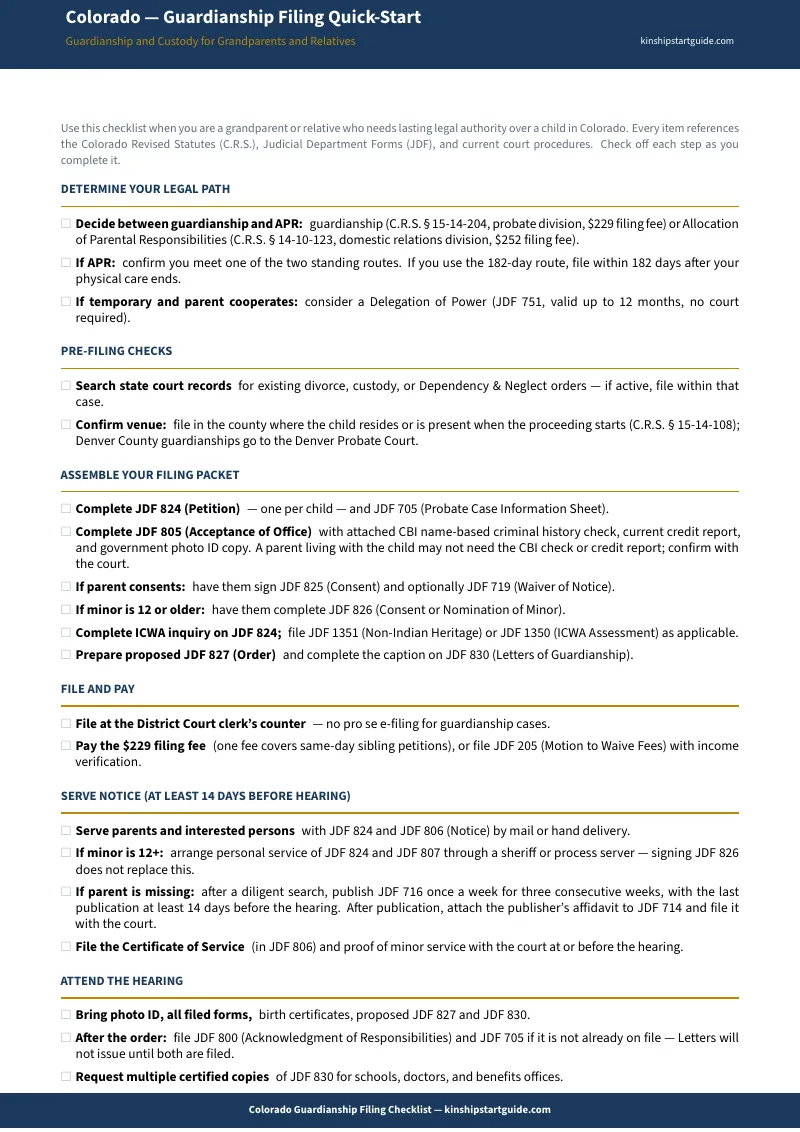
- Printable filing checklist — 24 items covering forms, fees, background checks, notice, and hearing preparation
- Service of process tracker — log every person served, track due diligence searches, and document publication service
- Caregiving timeline log — record your care history and calculate APR standing under the 182-day rule
- Hearing day document organizer — a binder checklist so you walk into the courtroom with every form in order
- Post-order compliance calendar — track your JDF 834 annual report deadline, immediate post-appointment tasks, and event-triggered notifications
- Agency communication log — record every call and visit with courts, schools, doctors, and benefits offices
All are formatted for printing on standard letter paper. Take them to the courthouse, to your meeting with a legal aid attorney, or keep them next to your computer while you fill out the forms.
Satisfaction Guarantee
If the guide isn't what you expected, email [email protected] for a full refund, no time limit. We read every message.
Frequently Asked Questions
Is this a replacement for a lawyer?
No. This guide explains the court process in plain language and helps you prepare your filing — it does not give legal advice, predict outcomes, or recommend whether to file for guardianship or custody. Many uncontested kinship cases are handled without an attorney, and the guide is designed for self-represented filers. For contested cases, legal representation is strongly recommended.
Does it include the actual court forms?
The guide references the required forms by their JDF numbers and explains where each fits in the filing sequence and which supporting documents to gather. It points readers to the Colorado Judicial Branch self-help forms page. The forms themselves are free from the state and always will be.
What if the parent won't cooperate with being served?
The guide covers notice and service for four scenarios: a parent who consents, a parent who doesn't respond, a parent in a correctional facility, and a parent who cannot be located. Each scenario includes the specific forms and procedures Colorado courts require.
Will this help me get financial assistance for the child?
The guide explains which legal orders qualify a child for benefits and where to apply, but detailed financial assistance navigation is covered in the separate Colorado Kinship Financial Help Guide.
I just need school enrollment and doctor visits — do I really need a court order?
Not always. Colorado allows some non-court options like a parental power of attorney (C.R.S. § 15-14-105) that may be enough for school and medical consent. The guide explains when these alternatives work and when they don't. For consent-specific guidance, see the Colorado School and Medical Consent Guide.
Frequently Asked Questions
What if the rules change after I buy?
We update the guide when the rules change. Email us any time, even years later, and we'll send you the current edition free.