The school says "bring a custody order." The clinic says "we need the parent." Neither is the whole story.
A child moved into your home because a parent couldn't manage — addiction, incarceration, illness, or just gone. Within days you needed to enroll that child in school and take them to a doctor. The school registrar asked for a custody order you don't have. The pediatric clinic said they need a biological parent's signature on the consent form. You left both offices without an answer, and the child still needs to start class on Monday and see a dentist before the pain gets worse.
Here's what neither office told you: Alaska law gives relatives a specific legal instrument — the Power of Attorney for a Minor under AS 13.26.066 — that delegates parental authority for school and medical decisions for up to one year. The Alaska Court System publishes the form (PG-701) for free. No court filing, no judge, no attorney fee. But this only works if it's executed correctly, says the right things, and is presented with the right supporting paperwork. A generic POA template downloaded from a national form site almost certainly uses the wrong statute and leaves out the scope language a school clerk or clinic receptionist needs to see.
The Alaska Kinship Authority Toolkit
This guide is a complete process-navigation system for getting a child enrolled in school and into a doctor's office when you are the grandparent or relative — not the parent. It walks through every form Alaska recognizes, explains the legal differences between them, and gives you the printable desk-counter tools to handle the moment a clerk or receptionist says no.
It covers the full landscape: the PG-701 Power of Attorney (up to one year, with a military active-duty exception), the minor's own consent rights under AS 25.20.025, McKinney-Vento enrollment protections, mental health consent boundaries, special education rights under IDEA, and the court guardianship petition under AS 13.26.132 for when a one-year delegation is no longer enough.
What's inside the guide
- Authority comparison matrix — the Power of Attorney under AS 13.26.066 (Form PG-701), the minor's own consent under AS 25.20.025, and court guardianship under AS 13.26.132 compared side by side: who qualifies, how long each lasts, what each one authorizes, and how to execute correctly with a notary
- School enrollment walkthrough — what Alaska's 54 school districts can legally require from a non-parent enrolling a child, the documents to bring, how to present PG-701 at the registration desk, and the exact steps when a registrar still refuses
- McKinney-Vento protections explained — how the federal law applies to kinship children in crisis, how to identify and contact the district homeless liaison, and how to trigger immediate enrollment while paperwork is pending
- Medical, dental, and routine health consent — what PG-701 authorizes at the clinic and the hospital, the limits on surgical and psychotropic medication consent, and how to present your paperwork to a receptionist who has never seen the form before
- Minor's own consent under AS 25.20.025 — when a minor can consent to their own medical or dental care without any parental or caregiver involvement, and how this intersects with the PG-701 delegation
- Mental health consent boundaries — outpatient counseling, psychotropic medication, inpatient admission, substance use treatment, and the 42 CFR Part 2 privacy rules that apply to adolescents
- Special education and Section 504 rights — how IDEA's broad "parent" definition may include a relative caregiver, how to request evaluations, and the authority you need for IEP meetings
- ICWA considerations — the Indian Child Welfare Act's role in custody and placement for Alaska Native children, the difference between state court and tribal court jurisdiction, and what ICWA means for informal kinship arrangements
- Desk-counter checklists and scripts — printable sheets for the school registration desk and the clinic reception desk, with polite escalation language and the statutory citations that resolve most refusals
- Incarcerated or unreachable parent workflows — how to coordinate execution of a POA when a parent is in a correctional facility, notarization procedures inside Alaska facilities, and the decision point for switching to a court petition
- Benefits the child may qualify for — Denali KidCare, ATAP child-only assistance, SNAP, Title IV-E Guardianship Assistance, school free-and-reduced-price meals, and Title VI Indian Education eligibility
- 12-month expiration tracker — a printable calendar to track delegation expiry dates, renewal windows, and statutory deadlines so nothing lapses without notice
- Escalation decision tree — when a desk refusal can be resolved with better paperwork, when to request a written administrative denial, and when to contact Alaska Legal Services Corporation
- Alaska contact directory — direct numbers for Alaska Legal Services (1-888-478-2572), Alaska 2-1-1, the Alaska Court System Self-Help Center, district McKinney-Vento liaisons, OPA, and the Alaska Bar Association Lawyer Referral Service
Who this is for
- Grandparents, aunts, uncles, adult siblings, and family friends in Alaska who have suddenly taken in a child and need to get that child enrolled in school and to the doctor — now
- Relatives who tried to register a child and were turned away at the school desk or the clinic because they don't have a custody order
- Caregivers in rural and Bush Alaska who face limited notary access, high printing costs, and district offices that may not be familiar with PG-701
- Adult children, social workers, tribal council members, or community volunteers buying a clear, printable resource on behalf of an older relative who needs step-by-step instructions
Why not just download the free court form?
You should download the free court form. The Alaska Court System publishes Form PG-701 at no charge, and this guide links directly to it.
But the form is a two-page blank judicial template. It doesn't tell you which legal pathway to use for your situation, what language the delegation needs to include for medical consent, whether one parent's signature is sufficient (it is), or what to say when the school clerk looks at your signed PG-701 and still insists on a court order. National form sites like eForms and LegalZoom sell generic minor POA templates that sometimes insert disclaimers from the wrong state. This guide fills the gap between having the form and knowing how to use it at the counter.
What this guide does not do
This is an independent preparation guide — not a government publication, not a legal service, and not an endorsement of any particular custody outcome. It does not provide legal advice about custody disputes or parental termination. It does not take sides in any family dispute. For legal questions specific to your situation, contact Alaska Legal Services Corporation at 1-888-478-2572 or the Alaska Bar Association Lawyer Referral Service.
Full refund, no time limit
If the guide does not help your situation, email [email protected] for an immediate refund. No deadline, no hoops.
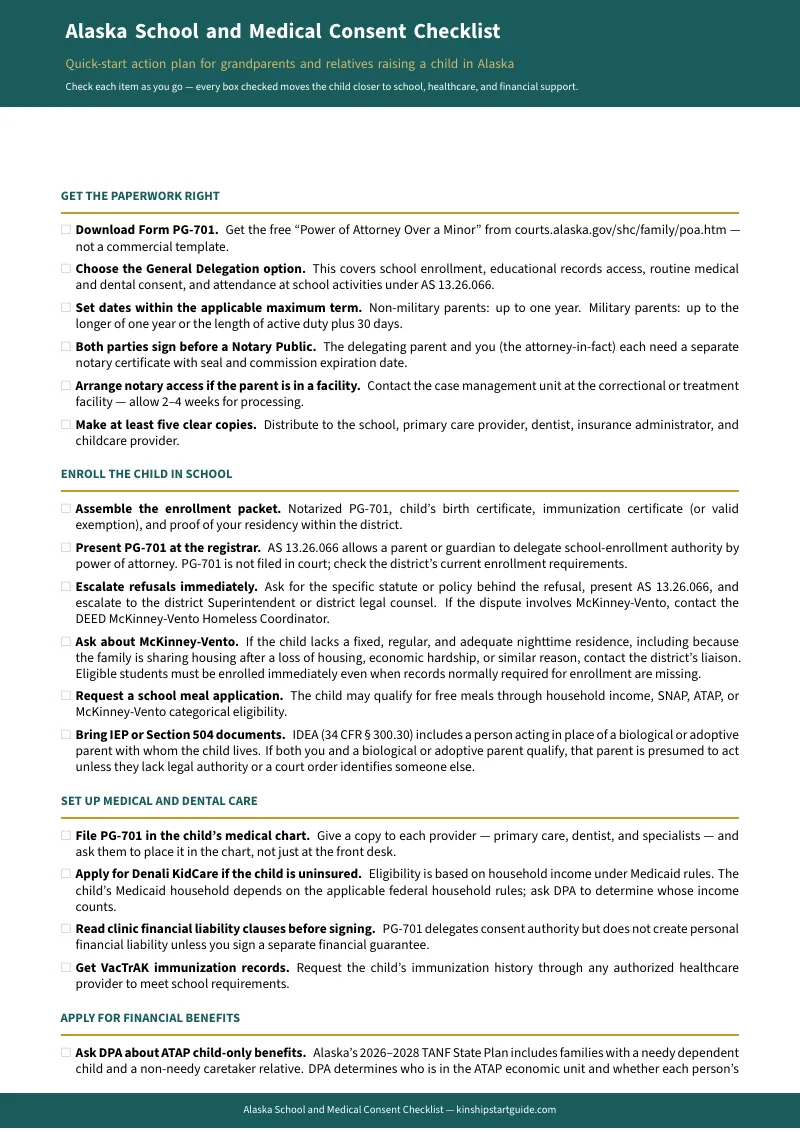
The free checklist gives you the highlights — the consent forms to know about, the enrollment steps, and the agencies to call. The full guide gives you the complete system: statute-by-statute comparisons, filled-out workflow examples, printable desk-counter scripts, and the tracking tools to make sure your paperwork never expires without notice.
Frequently Asked Questions
What if the rules change after I buy?
We update the guide when the rules change. Email us any time, even years later, and we'll send you the current edition free.