
You're raising a child you didn't plan for, on money that was already spoken for
A grandchild moved in a few weeks ago — or a niece, or a nephew. The birth parent can't cope, and the child is living with you now. You've bought a bed, school shoes, and a winter coat. You're feeding an extra person on a pension or a part-time wage that was already stretched. Someone at the council mentioned "kinship care allowance" and someone at Social Security Scotland mentioned the "Scottish Child Payment," but no one sat down and explained which office pays what, which forms you need, or how one payment affects another.
The money available to kinship carers in Scotland comes from three different layers — your local council, Social Security Scotland, and the DWP — and what you can claim depends on whether the child is formally looked after, whether you hold a Section 11 kinship care order, or whether you stepped in with no social work involvement at all. Apply to the wrong agency first and you lose months. Miss the Scottish Child Payment because nobody told you it's separate from the council allowance and you lose £28.20 a week that was never coming out of your allowance anyway. Never check your council's deduction notice and Child Benefit you haven't received yet gets subtracted from the money landing in your account.
The Tri-Agency Money Map: every payment, every agency, one printable guide
The Kinship Care Allowance and Money for Kinship Carers in Scotland guide gathers everything your council, Social Security Scotland, HMRC, and the DWP explain across hundreds of separate web pages into one step-by-step reference. At the centre is what we call the Tri-Agency Money Map — an arrangement-by-arrangement matrix that shows you exactly which payments each care status unlocks, who administers each one, and what to apply with, so you never spend weeks filling in forms at the wrong office or miss a payment you were entitled to all along.
This is not benefits advice, and it is not a government publication. It is an independent guide written in plain English for grandparents and relatives who need to find every payment the child qualifies for, understand how the payments interact, and get the applications right the first time.
What's inside
- Arrangement-by-arrangement matrix — a printable reference showing what private family carers, council-involved carers, looked-after-child placements, and Section 11 kinship order holders can each claim, from which agency, and what changes when your legal status changes
- Scottish Recommended Allowance deep dive — the 2026/27 rates (£177.68/wk for ages 0–4, £206.71 for 5–15, £283.35 for 16–17), how your council calculates net payments, what it can and cannot lawfully deduct, and how to challenge a calculation that looks wrong
- Deduction audit worksheet — a printable tool for checking your council's payment notice line by line against the benefits you've actually received, so you can spot a Child Benefit deduction applied before HMRC has even processed your claim
- Scottish Child Payment and Best Start Grants — how to claim £28.20 per week per child via Social Security Scotland, the higher £796.65 Pregnancy and Baby Payment for kinship placements, and the Early Learning and School Age lump sums at £331.95 — all legally protected from council deduction
- Child Benefit and Guardian's Allowance — how to claim on Form CH2 even when the birth parent hasn't released the claim, how to apply for tax-free Guardian's Allowance on Form BG1, and why claiming Child Benefit matters even when the council deducts it
- Universal Credit and the child element — why looked-after children are excluded from the UC child element, how the two-child limit abolition applies, and the overpayment trap that catches carers who don't update DWP when a child's status changes
- Pension Credit child addition — the overlooked route for grandparents over State Pension age who are not eligible for Universal Credit
- Disability-specific payments — Child Disability Payment, Carer Support Payment, and the Carer's Allowance Supplement for Scottish kinship carers providing 35 or more hours of care to a child receiving CDP
- Emergency placement money — Section 22 discretionary payments during the first seven days, interim payments while your 12-week assessment runs, and what to say to social work when you need money now
- Council tax, housing, and school costs — council tax reduction for kinship carers, the 25% single-person discount interaction, school clothing grants, free school meals, and educational maintenance allowances
- Two worked examples with verified arithmetic — a formal kinship carer with a looked-after child and a grandparent caring informally on Pension Credit, showing exactly what each would receive across all agencies, so you see the numbers, not just the rules
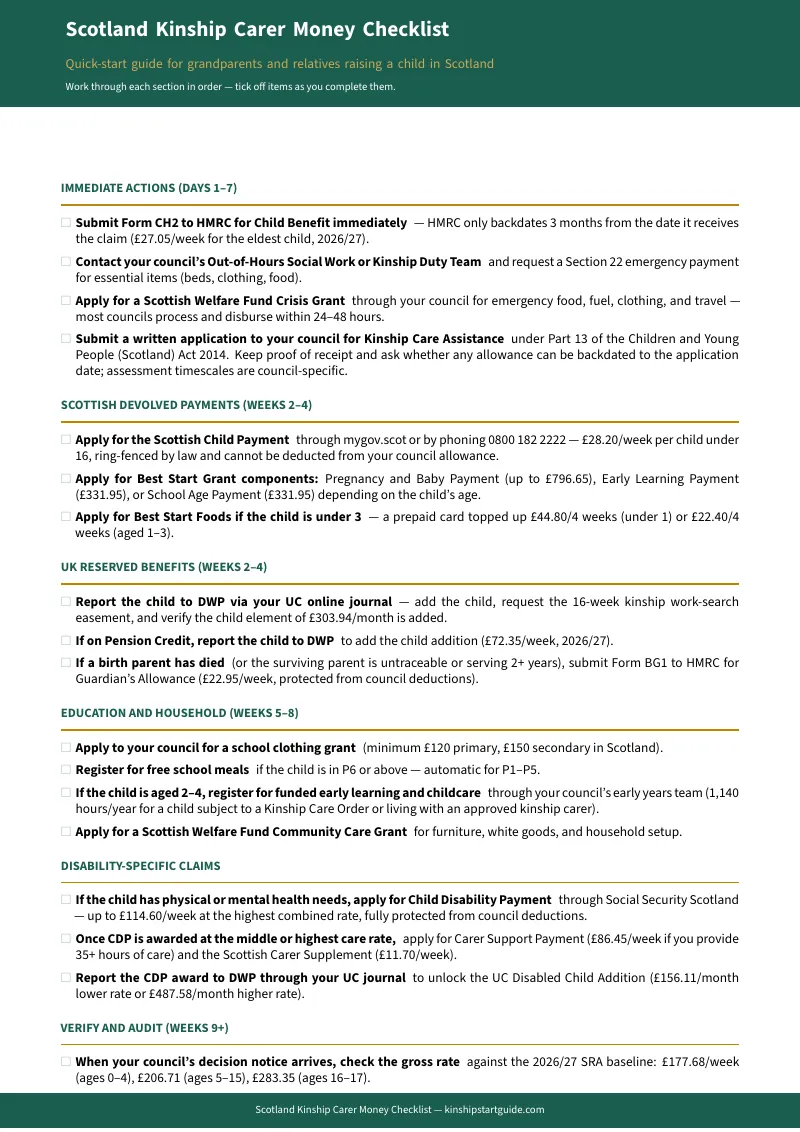
- Application checklist — every form, document, and deadline across all three agencies in one printable tracking sheet
- Multi-agency contact log — a dated record for calls, caseworker names, reference numbers, and written decisions across your council, Social Security Scotland, HMRC, and DWP
- Free helpline directory — KCASS (08000 28 22 33), Social Security Scotland (0800 182 2222), Citizens Advice Scotland, CPAG in Scotland, and Clan Childlaw
Who this is for
- Grandparents who just took on a grandchild. The child arrived suddenly. You're covering everything on a fixed income. You need to know what the child qualifies for and where to apply — before you spend another month paying out of your own savings.
- Relatives told "the council will help" but not told how. Social work mentioned a kinship allowance but didn't explain the assessment, the deduction rules, or the difference between the gross SRA rate and the net amount that actually hits your account. You're going in circles between your council and the DWP and neither is giving you a straight answer.
- Kinship carers whose deduction notice doesn't add up. Your council sent a payment letter showing a lower amount than the SRA rates you read online. You don't know what was deducted, whether the deductions are lawful, or whether the council is subtracting a benefit you haven't actually received yet.
- Informal carers with no social work involvement. You stepped in and the child is safe, but nobody contacted the council. You need to know which national benefits you can still claim, what changes if you apply for a Section 11 order, and whether it's worth asking social work to assess the placement formally.
- Helpers researching on someone's behalf. You're the adult child, niece, or family friend doing the online work because the grandparent raising the child is too overwhelmed or too exhausted to navigate government websites. You need a single document you can print and hand over.
Why not just use the free information?
The free information is good — and the guide links to all of it. mygov.scot explains the SRA rates. Social Security Scotland explains the Scottish Child Payment. GOV.UK explains Child Benefit. CPAG in Scotland publishes technical factsheets written for professional welfare rights advisers.
What none of them do is put your council, Social Security Scotland, HMRC, and the DWP side by side and show you how one payment affects another. The council allowance is on one website. The Scottish Child Payment is on another. The deduction rules are buried in a CPAG factsheet written for advisers, not for grandparents. Universal Credit child element exclusions are in a third place. If you're a grandparent on Pension Credit with a Section 11 order, caring for a disabled child, trying to claim Council Tax Reduction — good luck assembling the full picture from six separate portals while you're also doing the school run.
The guide does that assembly. It puts every payment, every deduction rule, and every form into one sequence, organised by your care arrangement. If a kinship navigator or KCASS adviser is already walking you through the system, the free resources may be enough. This guide is for people doing the navigation themselves.
Your purchase is protected
If the guide isn't useful to you, email [email protected] for a full refund, no time limit. No forms, no questions, no hassle.
The free checklist is available immediately with no purchase required — it lists every main payment type, who administers it, the key form numbers, and the helpline contacts.
Get the full Tri-Agency Money Map — the 45-page guide, deduction audit worksheet, arrangement matrix, agency communication log, application tracker, evidence checklist, emergency reference, and helpline directory — nine printable PDFs so you find out tonight what the child you're raising is entitled to.
Frequently Asked Questions
What if the rules change after I buy?
We update the guide when the rules change. Email us any time, even years later, and we'll send you the current edition free.