The school wants authority. The GP wants consent. The benefits office wants a court order. Nobody explained how Northern Ireland's system actually works.
A child arrived at your door — your grandchild, your niece, your nephew — because a parent couldn't cope. Addiction, prison, illness, death: the reasons are painful and they happened fast. Now you're raising this child in Northern Ireland, but the primary school won't let you sign a permission slip. The GP surgery says they can't register the child without someone holding Parental Responsibility. The benefits office wants documentation before they'll pay anything. A social worker mentioned a Residence Order, but the conversation ended before anyone explained which court, which forms, what it costs, or whether you even need the court's permission to apply.
You've searched online, and every "UK kinship care" guide turns out to be about England and Wales — Child Arrangements Orders, Cafcass reports, the C100 form. None of that applies in Northern Ireland. Northern Ireland has its own family law, its own courts, its own forms, its own legal aid system, and its own HSC Trusts. The English guides don't just miss the details — they point you at the wrong court, the wrong forms, and the wrong agencies.
The NI Kinship Navigator: every court step, Trust allowance and benefit claim in one printable folder
The Kinship Care in Northern Ireland process guide gathers everything the Northern Ireland Courts and Tribunals Service, the Legal Services Agency, the five HSC Trusts, the Department for Communities, and the kinship charities explain across dozens of separate web pages and policy documents into a single step-by-step household binder. It is built around what we call the NI Kinship Navigator — a structured set of printable worksheets, trackers, and checklists that organise every stage from checking whether you can apply as of right under Article 10, through filing your NICTS forms and surviving the assessment process, to claiming every allowance and benefit the child is entitled to once the order is made.
This is not legal advice, and it is not a government publication. It is an independent process guide written in plain English for grandparents and relatives who are navigating the Northern Ireland court process — whether you're acting without a solicitor or using the guide as an organiser alongside legal representation.
What's inside
- Article 10 standing checker — before you spend anything on court fees, you need to know whether you can apply as of right or need the court's permission first; the checker walks through the three-year qualifying care period under Article 10(5)(b) of the Children (Northern Ireland) Order 1995, including how to count non-continuous care periods over the preceding five years, so you know exactly where you stand before you file
- Form-by-form preparation guide — NICTS Forms C1, C1A, C1AA, C2, and C5 each serve a different purpose, and the wrong combination or a missing form delays your case by weeks; the guide maps each section of each form to plain-English explanations of what the court expects, with a preparation worksheet that gathers your answers before you touch the official forms
- Court fee and legal aid decision tree — the court filing fee depends on which tier your court sits in, but you may owe nothing; the decision tree maps fee remissions alongside Civil Legal Services through the Legal Services Agency Northern Ireland and the Green Form Scheme for initial advice, so you can see whether court, LSANI, or both should be covering your costs
- NIGALA and welfare assessment preparation worksheets — the court may appoint a Guardian Ad Litem through the Northern Ireland Guardian Ad Litem Agency and the HSC Trust may conduct its own welfare assessment; the worksheets organise your care history, household budget, the child's daily routine, schooling, health needs, and your support network so you walk into meetings with clear answers instead of scrambling
- Financial rights checklist — Residence Order Allowance from your HSC Trust, Universal Credit child elements from the Department for Communities, Child Benefit, Guardian's Allowance from HMRC, School Uniform Grant, and Free School Meals are administered by different offices with different forms; the checklist lists each one, which office to contact, and what to apply with, so no entitlement falls through the cracks
- IC1 NI informal care walkthrough — if you haven't applied for a court order yet but need Universal Credit to recognise that the child lives with you, you need the IC1 NI Informal Care Evidence Form verified by a social worker; the guide explains how to request the assessment proactively rather than waiting for DfC to contact you
- Post-order authority checklist — once the Residence Order is made, you need to register your new authority with the school, the GP surgery, the benefits office, and HM Passport Office; the checklist covers every notification step
- Application master checklist — a tracking sheet for every identity document, care history record, financial document, and form you need to assemble before filing
- Free helpline directory — Kinship Care NI's Caring for Kin Freephone Helpline (0800 022 3129), Law Centre NI (028 9024 4401), the Children's Law Centre CHALKY line (0808 808 5678), Advice NI, and the LSANI enquiries line
Who this is for
- Grandparents who need lasting legal authority. A parent can't care for the child because of addiction, imprisonment, illness, or death. The child lives with you in Northern Ireland. You need an order that gives you Parental Responsibility — and you need schools, doctors, and benefits offices to recognise that authority.
- Relatives blocked by paperwork walls. The school, GP, or benefits office wants proof of your authority. You've been managing informally, but informal care isn't enough any more and you need to understand which Northern Ireland court order fits your situation.
- Carers confused by English guides. Every "UK" guide you've found describes Child Arrangements Orders, Cafcass, and the C100 form — none of which exist in Northern Ireland. You need a guide that covers the Children (Northern Ireland) Order 1995, NICTS forms, HSC Trusts, and NIGALA.
- Relatives who can't afford a solicitor. Private family law representation in Northern Ireland starts at £150–£300 an hour. Legal aid thresholds are strict and carers with modest savings are routinely disqualified. You need to understand the court process well enough to prepare thoroughly on your own.
- Helpers researching on someone's behalf. You're the adult child, niece, or family friend doing the online research because a grandparent is too overwhelmed or not confident navigating government websites. You need clear, printable materials you can hand over.
Why not just use the free information?
The free information is excellent — and the guide links to all of it. Kinship Care NI runs the Caring for Kin Helpline. Law Centre NI offers specialist social security advice. The Children's Law Centre runs the CHALKY line. NICTS publishes court forms. nidirect publishes benefit guidance.
What none of them do is put all of those pieces into a single, structured, printable sequence that a stressed relative can follow from start to finish. The government guidance is written for social workers, not grandparents. The court service publishes forms but doesn't explain how to fill them in. The HSC Trust publishes Residence Order Allowance policy in administrative PDFs that carers can rarely find. The charities each cover a different slice of the process. The guide does that assembly work for you — and adds the preparation worksheets, standing checker, financial rights checklist, and decision trees that no free resource currently offers in a printable format.
If you have a social worker who is walking you through every step, or a solicitor who is handling the court paperwork, the free resources may be everything you need. The guide is for people who are organising the process themselves.
Your purchase is protected
If the guide isn't useful to you, email [email protected] for a full refund, no time limit. No forms, no questions, no hassle.
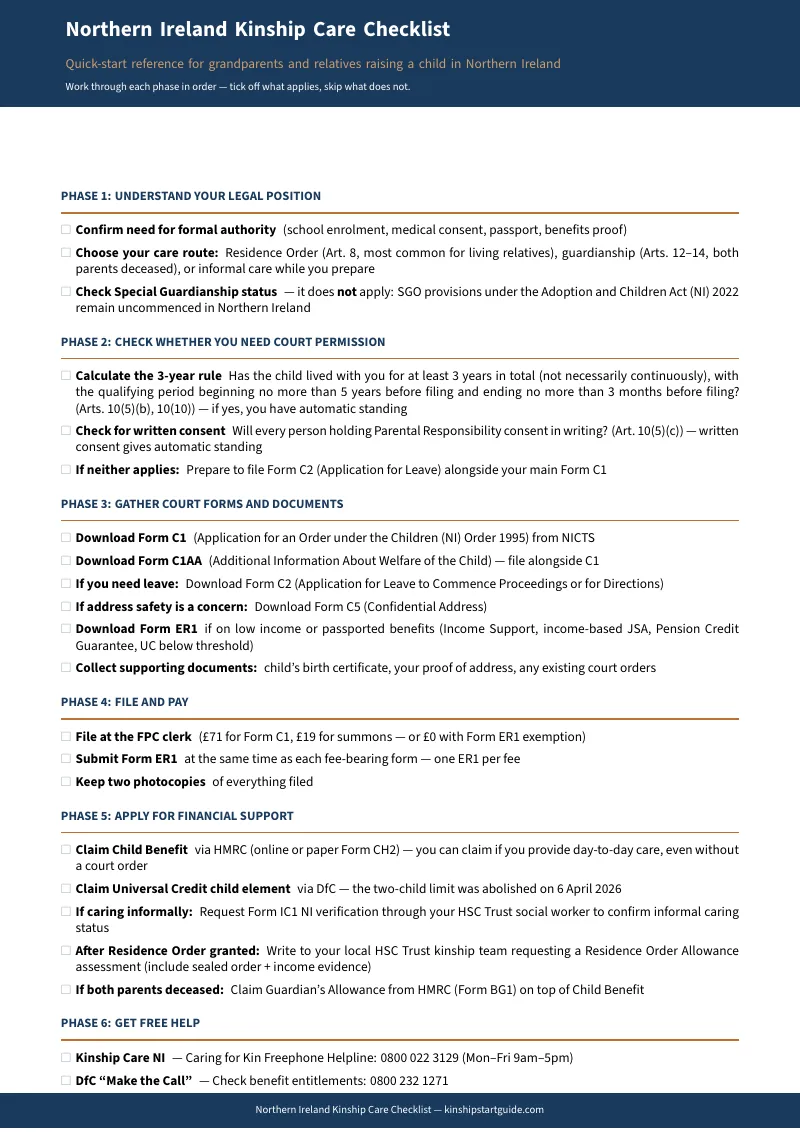
The free checklist is available immediately with no purchase required — it covers the main milestones and links to every free helpline and official resource.
Get the full NI Kinship Navigator — 12 printable PDFs including the complete process guide, standalone worksheets, trackers, a decision tree, a model letter, and a helpline directory — and start organising the application tonight.
Frequently Asked Questions
What if the rules change after I buy?
We update the guide when the rules change. Email us any time, even years later, and we'll send you the current edition free.