You've been told to "get an order." Nobody told you which one.
The school won't accept your signature. The GP surgery wants proof you can consent to treatment. The benefits office says you need formal parental responsibility before the child can claim what they're owed. A social worker mentioned a special guardianship order — but the conversation ended before she explained the difference between an SGO and a child arrangements order, which court forms to use, or what the council assessment actually looks at.
Meanwhile, you're raising a child you didn't plan to raise, on money you didn't plan to spend, and the three-month notice clock you didn't know about is already running.
The SGO Application Binder: every form, deadline and assessment step in one printable folder
The Special Guardianship Orders in England process guide gathers everything the government, the court service, and the charities explain across dozens of separate web pages into a single step-by-step household binder. It is built around what we call the SGO Application Binder — a structured set of printable worksheets, trackers, and checklists that organise every stage of the application from your first written notice to the local authority through to the final hearing and the support plan that follows.
This is not legal advice, and it is not a government publication. It is an independent administrative guide written in plain English for grandparents and relatives who are navigating the SGO process without a solicitor — though it works equally well as an organiser alongside legal representation.
What's inside
- Step-by-step process map — the five phases from deciding whether an SGO is the right order, through the three-month local authority notice, the C13A assessment, the court application, the hearings, and the support plan, laid out in the order you'll actually do them
- Form-by-form directory — plain-English explanations of Forms C1, C13A, FM1, C8, EX160, and C2, with direct links to the official GOV.UK download pages, so you never confuse the C1 (for an SGO) with the C100 (for a child arrangements order) and waste a filing fee
- Council notice template and communication log — a ready-to-adapt written notice letter that satisfies the statutory three-month requirement, plus a dated log to record every call, email, letter, and visit with your assigned social worker
- Assessment preparation worksheets — structured sheets for organising your household budget, the child's daily routine, their schooling and health needs, your care history, and your support network, so you walk into the C13A assessment with clear answers instead of scrambling for paperwork
- SGO vs CAO vs foster care comparison table — a side-by-side matrix showing what enhanced parental responsibility actually means in practice: who can consent to medical treatment, who can change the child's school, who can take the child abroad, and what each order means for the birth parents' legal role
- Allowance and support plan breakdown — how the means-tested special guardianship allowance works, how it interacts with Child Benefit and Universal Credit, what the 2026–2029 Kinship Zones pilot covers in seven councils, and what to raise in your support plan meeting before the order is made
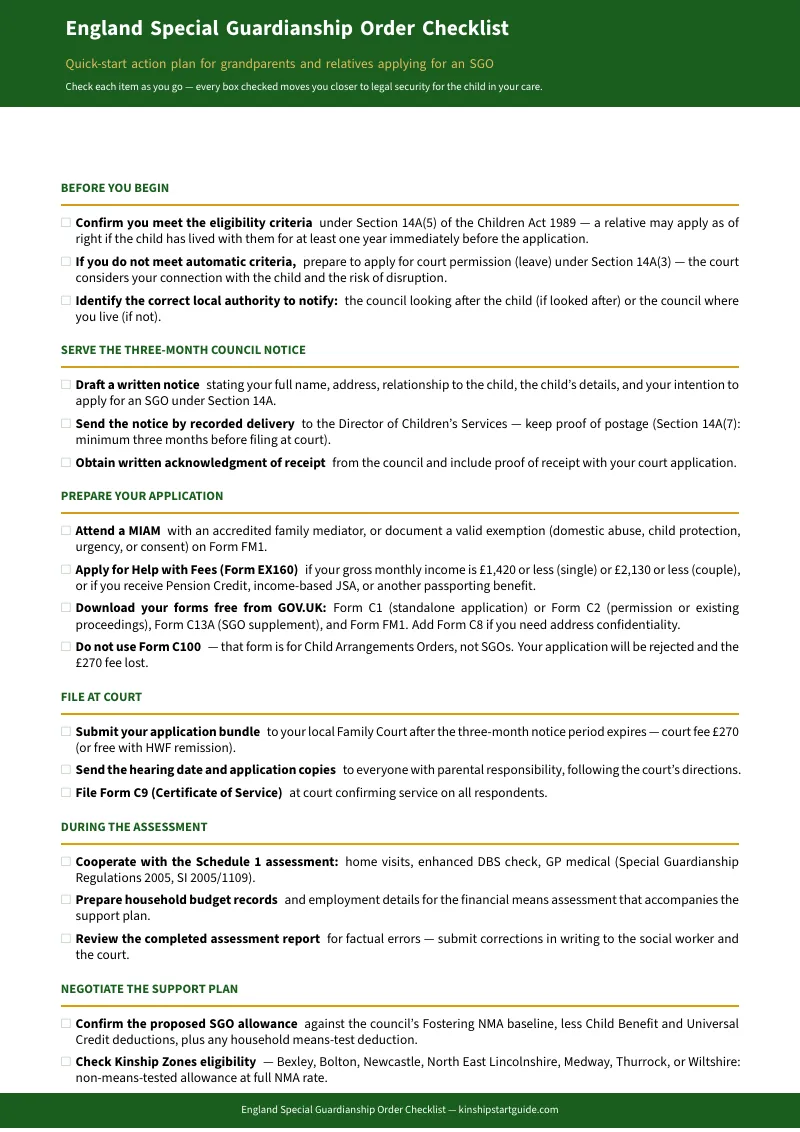
- Application checklist — a master tracking sheet for every identity document, medical record, school report, and completed form you need to assemble before filing
- Free helpline directory — Kinship (0300 123 7015), Family Rights Group (0808 801 0366), Child Law Advice, Support Through Court, and your local authority's kinship team
Who this is for
- Grandparents who need lasting legal authority. A parent can't care for the child because of addiction, imprisonment, illness, or death. The child lives with you. You need an order that gives you parental responsibility without adopting and without severing the child's birth family ties.
- Relatives blocked by paperwork walls. The school, GP, or benefits office wants proof of your authority. You've been managing informally, but informal care isn't enough any more and you need to know whether an SGO or a child arrangements order is the right next step.
- Carers preparing for the council assessment. Children's services have contacted you, a social worker has been assigned, and you want to understand exactly what the C13A suitability assessment covers — and how to organise your household information before the visits begin.
- Helpers researching on someone's behalf. You're the adult child, niece, or family friend doing the online research because a grandparent is too overwhelmed, too exhausted, or not confident navigating government websites. You need clear, printable materials you can hand over.
Why not just use the free information?
The free information is excellent — and the guide links to all of it. GOV.UK explains the court fee. Kinship explains what an SGO is. Family Rights Group explains what to do if social services are involved. The HMCTS form directory lets you download every form you need.
What none of them do is put all of those pieces into a single, structured, printable sequence that a stressed relative can follow from start to finish without toggling between eight browser tabs, five charity websites, and a stack of court forms they're not sure apply to their situation. The guide does that assembly work for you — and adds the preparation worksheets, tracking logs, and comparison tables that no free resource currently offers in a printable format.
If you have an allocated social worker who is walking you through every step, or a local kinship navigator programme that's handling the paperwork, the free resources may be everything you need. The guide is for people who are organising the process themselves.
Your purchase is protected
If the guide isn't useful to you, email [email protected] for a full refund, no time limit. No forms, no questions, no hassle.
The free checklist is available immediately with no purchase required — it covers the five main milestones and links to every official form and free helpline.
Get the full SGO Application Binder — the complete process guide, worksheets, trackers, and comparison tables — and start organising the application tonight.
Frequently Asked Questions
What if the rules change after I buy?
We update the guide when the rules change. Email us any time, even years later, and we'll send you the current edition free.