You're raising a child you didn't plan for, on money that was already spoken for
A grandchild arrived a few weeks ago — or a niece, or a nephew. The birth parent can't cope, and the child is living with you now. You've bought a bed, school shoes, and a winter coat. You're feeding an extra person on a pension or a part-time wage. Someone at the council mentioned "financial support" and someone at the Jobcentre mentioned "child elements," but no one sat down and explained which office pays what, which forms you need, or how one payment affects another.
The money available to kinship carers in England comes from three different places — HMRC, the Department for Work and Pensions, and the local authority — and what you can claim depends on whether you have a special guardianship order, a child arrangements order, or no order at all. Apply to the wrong department first and you lose months. Miss a form and you lose National Insurance credits that protect your State Pension. Never ask the council for its written means-test policy and your allowance calculation goes unchallenged even when it is wrong.
The Kinship Money Map: every payment, every agency, one printable guide
The Money for Kinship Carers in England guide gathers everything HMRC, DWP, and the 152 English councils explain across hundreds of separate web pages into a single step-by-step reference. At the centre is what we call the Kinship Money Map — an arrangement-by-arrangement matrix that shows you exactly which payments each legal status unlocks, who administers each one, and what to apply with, so you never spend weeks filling in forms at the wrong office or miss a payment you were entitled to all along.
This is not benefits advice, and it is not a government publication. It is an independent guide written in plain English for grandparents and relatives who need to find every payment the child qualifies for, understand how the payments interact, and get the applications right the first time.
What's inside
- Arrangement-by-arrangement matrix — a printable reference showing what informal carers, child arrangements order holders, and special guardians can each claim, from which agency, and what changes when your legal status changes
- Special guardianship allowance deep dive — how the means test works, what councils are and aren't allowed to deduct, and a template letter for requesting the written calculation so you can challenge it if the figures look wrong
- Child arrangements order allowances — what the "lives with" condition unlocks, how child arrangements order holders can access local authority support, and where CAO allowances overlap with (or replace) national benefits
- DfE Kinship Allowance Pilot (April 2026) — the seven pilot councils (Bexley, Bolton, Newcastle, North East Lincolnshire, Medway, Thurrock, Wiltshire), the non-means-tested weekly rate, exactly which benefits it is disregarded for, and the capital-limit interaction nobody mentions
- Child Benefit and Guardian's Allowance — how to claim on Form CH2 even when the birth parent hasn't released the claim, how to apply for tax-free Guardian's Allowance on Form BG1, and how claiming Child Benefit protects a grandparent's State Pension through NI credits
- Universal Credit and the carer element — the child element, the carer element, how the two-child limit abolition applies, why Carer's Allowance is deducted pound-for-pound but the UC carer element is not, and the capital rules that catch carers receiving lump-sum backdated allowances
- Pension Credit child addition — the overlooked route for grandparents over State Pension age who are not eligible for Universal Credit
- DLA and the carer element it unlocks — how a child's Disability Living Allowance award triggers the carer element in Universal Credit without a separate Carer's Allowance claim reducing your payment
- Adoption and Special Guardianship Support Fund (ASGSF) — the £3,000 per child annual Fair Access Limit for therapeutic support, funded through 2028
- Council kinship local offers — what your council is now required to publish, how to find it, and how to request your council's statutory family and friends care policy in writing
- Two worked examples with verified arithmetic — a special guardian with an SGO and a grandparent in informal care on Pension Credit, showing exactly what each would receive across all agencies, so you can see the numbers, not just the rules
- Application checklist — every form, document, and deadline across all three agencies in one printable tracking sheet
- Multi-agency contact log — a dated record for calls, caseworker names, reference numbers, and written decisions across HMRC, DWP, and the council
- Free helpline directory — Kinship (0300 123 7015), Family Rights Group (0808 801 0366), Citizens Advice, Child Poverty Action Group, and Child Law Advice
Who this is for
- Grandparents who just took on a grandchild. The child arrived suddenly. You're covering everything on a fixed income. You need to know what the child qualifies for and where to apply — before you spend another month paying out of your own savings.
- Relatives told "the council will help" but not told how. Children's services mentioned an allowance but didn't explain the application, the means test, or the forms. You're going in circles between DWP and the council and neither is giving you a straight answer.
- Special guardians who suspect the means test is wrong. Your council sent a decision letter with a number on it but no breakdown. You don't know what they deducted or whether the calculation followed their own policy. You need the questions to ask and a template to ask them.
- Kinship carers in a pilot council. You've heard about the new non-means-tested allowance but aren't sure whether you qualify, whether it reduces your Universal Credit, or what happens if the money builds up in your bank account past the capital threshold.
- Helpers researching on someone's behalf. You're the adult child, niece, or family friend doing the online work because the grandparent raising the child is too overwhelmed or too exhausted to navigate government websites. You need a single document you can print and hand over.
Why not just use the free information?
The free information is good — and the guide links to all of it. GOV.UK explains Child Benefit. Kinship explains SGO allowances. The DWP journal explains Universal Credit. Citizens Advice explains Pension Credit. Child Poverty Action Group publishes technical welfare rights handbooks.
What none of them do is put HMRC, DWP, and the local authority side by side and show you how one payment affects another. Child Benefit is on one website. The SGO allowance is on another. Universal Credit capital rules are on a third. The Kinship Allowance Pilot disregard rules are buried in a council FAQ. If you're a grandparent on Pension Credit with an SGO, raising a child with DLA, in a pilot council — good luck assembling the full picture from six separate government portals while you're also doing the school run.
The guide does that assembly. It puts every payment, every interaction rule, and every form into one sequence, organised by your arrangement type. If a kinship navigator or allocated social worker is already doing this for you, the free resources are probably enough. This guide is for people doing the navigation themselves.
Your purchase is protected
If the guide isn't useful to you, email [email protected] for a full refund, no time limit. No forms, no questions, no hassle.
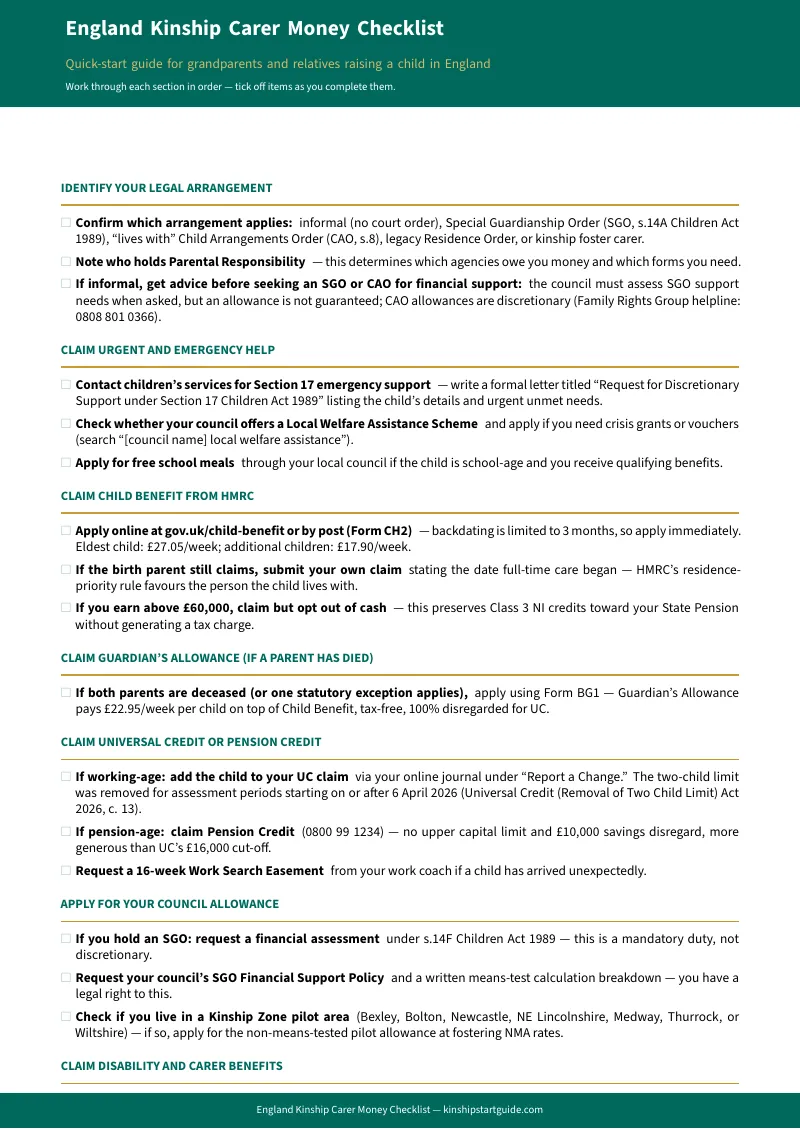
The free checklist is available immediately with no purchase required — it lists every main payment type, who administers it, the key form numbers, and the helpline contacts.
Get the full Kinship Money Map — the complete guide, worksheets, worked examples, and contact logs — and find out tonight what the child you're raising is entitled to.
Frequently Asked Questions
What if the rules change after I buy?
We update the guide when the rules change. Email us any time, even years later, and we'll send you the current edition free.