
The school wants proof you can sign for this child. The hospital wants proof. Retraite Québec wants proof. And you have no idea where to start.
You are raising a grandchild, a niece, a nephew — or maybe a younger sibling — in Quebec. The child arrived during a crisis and you stepped in because no one else would. Now every institution in this province wants a piece of paper you do not have.
The school board asks for a jugement de tutelle. The clinic says they need parental authority in writing. The CRA wants to know who the "primary caregiver" is before they release the Canada Child Benefit. Retraite Québec tells you the Family Allowance stays with the biological parent until you file forms in French that you have never seen.
You Google "grandparent guardianship Quebec" and the results are either American legal form kits (useless here — Quebec does not recognize common-law guardianship) or $200-an-hour notary websites that skip every step between "call us" and "pay us."
The Quebec Kinship Roadmap: one organized path from informal care to legal authority and the child's benefits
Raising a Grandchild in Quebec is a plain-language organizational toolkit built for the exact situation you are in: an English-speaking relative navigating a French-language civil law system with no lawyer, no caseworker, and no time to read three provincial ministry websites plus the Canada Revenue Agency.
The guide consolidates everything into a single bilingual workflow — the tutorship routes, the court and notary processes, the filing fees and Legal Aid thresholds, the Family Allowance transfer, the Canada Child Benefit, and the financial assistance program for children who came through youth protection — so you stop searching and start moving.
What's Inside
- All four tutorship routes mapped out — Suppletive tutorship (when a parent agrees to share authority), dative tutorship (when both parents are gone or incapable), YPA Art. 70.1 tutorship (for children placed through youth protection), and informal care with its limits. Each route gets its own chapter with the exact steps, the forms you need, and who to file with.
- Bilingual term translations — Every French legal and administrative term you will encounter (tutelle supplétive, requête, procès-verbal, Allocation famille) mapped to a plain-English explanation, so you understand what the court clerk or notary is asking for.
- The complete money chapter — How to transfer the Retraite Québec Family Allowance (up to $3,068 per child annually), apply for the Canada Child Benefit through Form RC66, and claim the LPJ financial assistance under Decree 1914-2023, including the 60-day post-judgment application window that most families miss.
- Filing costs and Legal Aid thresholds — The $205 Superior Court filing fee, notary fee ranges ($1,500–$3,500), and exactly where the free Legal Aid ceiling sits ($30,212 single-person income) and where the contributory tier begins, so you know your options before you walk in.
- The property threshold rule — If the child's property exceeds $40,000, the Curateur public gets involved and a Tutorship Council becomes mandatory. The guide explains when this applies, how to declare the property inventory, and how to manage annual reporting.
- Emergency safeguard orders — What to do if a parent poses an immediate risk to the child, how urgent court applications work, and the interim powers a judge can grant while a full tutorship application is underway.
- English-language support directory — Legal Aid offices, Centres de justice de proximité, CANGRANDS, the Quebec Community Groups Network, and regional bilingual resources organized by area.
Who This Is For
- Grandparents raising a grandchild after a parent's addiction, incarceration, illness, or death
- Aunts, uncles, adult siblings, or their spouses who have taken in a child and need legal standing
- Relatives whose informal care arrangement is breaking down — the school or hospital has started refusing your signature
- Kinship carers who already have tutorship and need to transfer the child's provincial and federal benefits
- English-speaking families navigating Quebec's French-language court and benefits systems
Why Free Online Resources Are Not Enough
The information exists — scattered across four separate websites. The Curateur public du Québec handles property oversight but says nothing about school consent. The Ministère de la Justice provides raw court forms in French with no instructions for non-lawyers. Retraite Québec explains the Family Allowance but assumes you already have the tutorship judgment. The CRA's Canada Child Benefit page uses federal terminology that does not map to Quebec civil law concepts.
You are not missing one document. You are missing the thread that connects them. That thread — which route to take, what to file first, what proof unlocks which benefit, and in what order — is what this guide provides. One document, one workflow, in English.
What This Guide Is Not
This is not legal advice. It does not tell you whether to pursue tutorship, does not predict what a court will decide, and does not replace a lawyer or notary for contested proceedings. It is an organizational toolkit that helps you understand the process, prepare your documents, and arrive at every appointment — with Legal Aid, a notary, or a court clerk — already knowing what they will ask for.
If a child is in immediate danger, call the Director of Youth Protection (DPJ) at 1-800-463-9009 or 911. If your income is below the Legal Aid threshold, your first call should be to the Commission des services juridiques — they represent you for free.
Full refund, no time limit
If the guide does not help you, email [email protected] and you will receive a full refund. No time limit, no questions, no conditions.
Your free checklist shows you the steps. The full guide shows you how to take them.
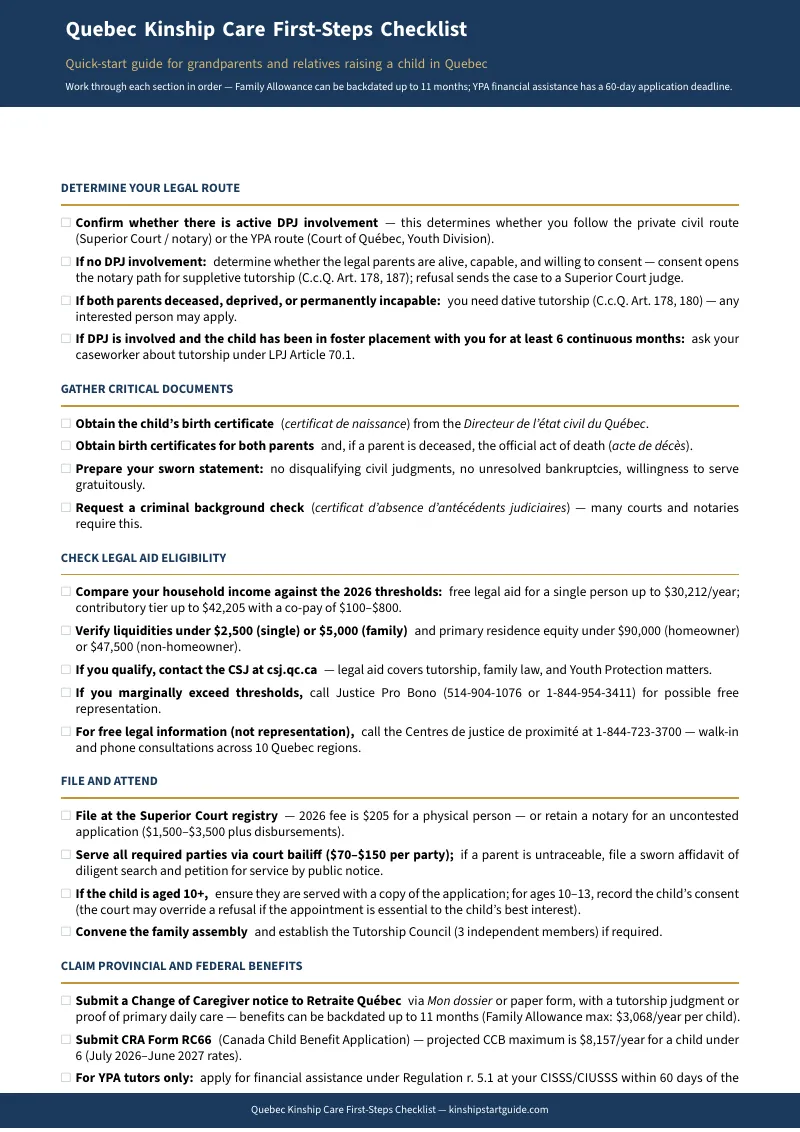
The free Quebec Kinship Checklist gives you the overview — the key first steps when a child arrives. The full Raising a Grandchild in Quebec toolkit gives you the detailed route maps, the bilingual term translations, the benefit worksheets, the filing cost breakdowns, and the support directory that turns those steps into a completed process.
Download the free checklist to see if the approach works for you. When you are ready for the complete roadmap, the full guide is here — for less than a single hour of a notary's time.
Frequently Asked Questions
What if the rules change after I buy?
We update the guide when the rules change. Email us any time, even years later, and we'll send you the current edition free.