The Money Exists. The Problem Is Knowing Which Office Pays It — And What Your Arrangement Changes.
A child has moved into your home — maybe overnight, maybe after weeks of growing worry — and your pension is now covering groceries, school supplies, winter coats, and childcare for two. Nova Scotia has monthly payments, federal tax credits, child care subsidies, and disability supports earmarked for this child. But the money sits across two levels of government, and which payments you can actually claim depends on whether your arrangement is an informal family agreement, a placement through the Alternative Family Care program, or a court order under the Parenting and Support Act.
The Department of Opportunities and Social Development explains AFC on one page but doesn't mention the CRA. The CRA explains Form RC66 but doesn't know your provincial options. The Nova Scotia Child Benefit pays automatically — if you've already claimed the CCB. Meanwhile, the Canada Child Benefit may still be flowing to the biological parent's bank account every month, even though the child eats breakfast at your table.
The Care Arrangement Navigator inside this guide starts with your actual situation — not a programme name — and maps it to every payment, allowance, and support the child qualifies for. You see at a glance which chapters, forms, and agencies apply to your care arrangement. No wrong applications. No wasted calls to the wrong office.
What's Inside
A 49-page guide covering every financial support available to grandparents and relatives raising a child in Nova Scotia, with application instructions for each one:
- Care arrangement comparison table — see how informal care, parental written consent, a court order under the Parenting and Support Act, and a formal kinship placement each open or close different financial doors, with specific dollar amounts for each pathway
- Canada Child Benefit transfer walkthrough — how to complete CRA Form RC66 step by step, the evidence checklist the CRA accepts when a biological parent won't sign the transfer, how long processing takes, and how far back the CRA will backdate payments
- Alternative Family Care (AFC) program — the $500 start-up grant, $750/month ongoing per child, how to access AFC when your family is not already involved with child protection, and confirmation that AFC payments are non-taxable and won't reduce your GIS, OAS, or Income Assistance
- Nova Scotia Child Benefit and GST/HST Credit — automatic top-ups that flow once your CCB is active, worth up to $127.08/month per child, with no separate application required
- Employment Support and Income Assistance (ESIA) — what a court order changes in your ESIA eligibility, the personal and shelter allowances, and how ESIA interacts with other benefits
- Child care subsidies — income-tested subsidies with no asset test or work requirement, how to apply at childcarenovascotia.ca, and how a CCB claim or court order changes what you qualify for
- Disability supports — Direct Family Support for Children (DFSC) respite funding, the Disability Tax Credit T2201 process, and the Child Disability Benefit that the CRA adds automatically once the DTC is approved
- CPP Surviving Child Benefit — what the child receives when a parent has died or is disabled, Form ISP-1300, and worked examples showing the calculation
- Court process under the Parenting and Support Act — the mandatory "leave of court" requirement for non-parents, the forms (Form 59.07, FD1, FD2A), summary advice counsel, and how a court order changes your financial picture
- Appeals and reviews — how to challenge an ESIA denial within 30 business days, the Assistance Appeal Board process, and the CRA Notice of Objection route for a CCB denial
Plus a printable checklist (every payment and support on one page) and six planning tools formatted for printing and filling in by hand:
- Application Tracking Log — log every application, reference number and follow-up deadline across the CRA, OSD, Service Canada and the courts
- Document Gathering Checklist — every document you may need, with checkboxes and a column for where each original is stored
- Agency Communication Log — record every call, visit and email so you have an evidence trail if advice conflicts or paperwork goes missing
- Change-of-Circumstances Checklist — when something changes, which agencies to notify and within what timeframe
- Free-Help Appointment Checklist — prepare your three questions, gather your documents, and capture answers and action items during the appointment
- Annual Deadline Calendar — tax filing, benefit recalculations, programme renewals and appeal windows in one year-at-a-glance sheet
Who This Is For
- Grandparents on a fixed income who are covering a grandchild's daily costs out of CPP, OAS, GIS, or a modest pension and did not budget for a child
- Aunts, uncles, older siblings, and family friends who took in a child with little notice and need to know which payments apply before the next school bill is due
- Informal caregivers who have not contacted the Department of Opportunities and Social Development and don't know what they can claim without a court order or a department file
- Relatives exploring the AFC program who want to understand the $500 start-up and $750/month payments, how to access the program, and what happens when the arrangement ends
- Relatives considering a court order — whether for parenting time, decision-making responsibility, or guardianship — who want to understand the financial consequences before committing
- Family members helping from a distance — an adult child, a sibling, or a community worker researching benefits on behalf of the grandparent doing the day-to-day caregiving
Why Not Just Use the Free Government Pages?
The Nova Scotia government publishes programme details across dozens of pages on novascotia.ca. The CRA publishes Form RC66 instructions in federal-government language. The Legal Information Society of Nova Scotia and the Family Law Information Program publish overviews of court procedures. Every one of these resources is valuable, and the guide includes their contact details, phone numbers, and direct links.
What none of them does is start from your care arrangement, walk you through the specific benefits you qualify for in order, tell you which agency handles each one, give you a checklist of documents to gather before your first call, explain what to do when one programme's payment affects another, and hand you a single organized reference that connects the federal and provincial systems.
A family lawyer in Halifax charges $250 to $500 an hour. Summary Advice Counsel at the courthouse gives you 30 free minutes. This guide costs — and it's focused on the financial navigation that neither a lawyer nor a caseworker typically covers: not court strategy, but the monthly payments, tax credits, and allowances the child is entitled to.
Full Refund, No Time Limit
If the guide isn't what you expected, email [email protected] and you'll get a full refund. No time limit, no questions.
Get Started
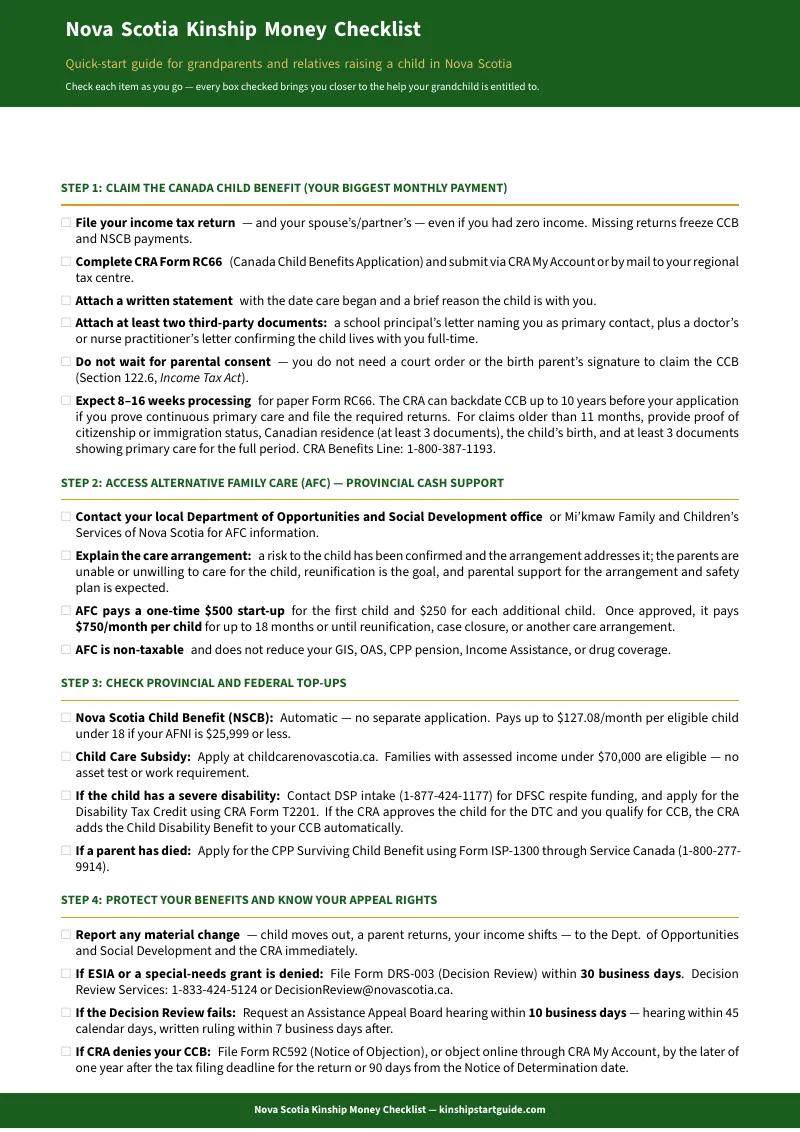
Download the free Nova Scotia Kinship Money Checklist — a one-page summary of the payments available and which agency runs each one. If you want the full application instructions, evidence checklists, the Care Arrangement Navigator, and all six printable planning tools, get the complete kit for .
Frequently Asked Questions
What if the rules change after I buy?
We update the guide when the rules change. Email us any time, even years later, and we'll send you the current edition free.