You're raising a child you didn't plan for, and two separate governments want two separate sets of paperwork
A grandchild turned up last week — or a niece, or a nephew. The parent can't cope, and now the child is living with you. You've bought a cot, a car seat, school shoes, and enough groceries to feed an extra person, all on a pension that was already tight. Someone at Centrelink mentioned "Family Tax Benefit" and someone at the Department of Communities and Justice mentioned "care allowances," but nobody explained which agency pays what, which application goes where, or what happens when you don't have a court order.
The support available to a kinship carer in New South Wales comes from two entirely separate systems — the federal one (Services Australia, which runs Centrelink) and the state one (NSW DCJ) — and what you can claim depends on whether you have a Children's Court care order, a Family Court parenting order, or no order at all. Apply to the wrong office first and you lose weeks. Call the Centrelink helpline without the right documents and the call ends with "we'll get back to you." Miss the 35% care threshold and your Family Tax Benefit claim is rejected with no explanation of what went wrong.
The NSW Kinship Navigation System: two agencies, one guide, no confusion
The Support for Grandparents and Kinship Carers in NSW guide takes the information scattered across hundreds of separate Services Australia and DCJ pages and puts it into a single step-by-step reference. At its core is the NSW Kinship Navigation System — a care-arrangement matrix that shows you exactly which payments each legal status unlocks, whether they come from Centrelink or from DCJ, and what documents you need for each, so you never spend another fortnight filling in forms at the wrong office or missing a payment the child was entitled to from the start.
This is not benefits advice, and it is not a government publication. It is an independent guide written in plain English for grandparents and relatives who need to find every payment and service the child qualifies for, understand how the two systems interact, and get the applications right the first time.
What's inside
- Care-arrangement matrix — a printable reference showing what informal carers, those with Children's Court care orders, Family Court parenting orders, and guardianship orders can each claim, from which agency, and what changes when your status changes
- DCJ care allowances explained — Statutory Care Allowance, Supported Care Allowance, Guardianship Allowance, and Adoption Allowance with the current fortnightly rates by age bracket ($714–$1,081), plus establishment and emergency payments for crisis placements (up to $1,400)
- Centrelink for non-parent carers — Family Tax Benefit Parts A and B, the Additional Child Care Subsidy (ACCS) Grandparent stream providing up to 100 hours of fully subsidised childcare per fortnight, Double Orphan Pension, Carer Allowance and Carer Payment, the Foster Child Health Care Card, and the principal carer exemption from mutual obligation
- Proof-of-care preparation worksheet — the specific documents you need to establish non-parent care with Services Australia when you have no court order, including the 35% actual care threshold, non-parent statutory declarations under the Oaths Act 1900, and what to prepare before your first call
- 1800 245 965 Adviser Line phone script — a step-by-step call preparation guide for the Grandparent, Foster and Kinship Carer Adviser Line, so you know exactly what to ask and what to have in front of you, turning a frustrating call into an approved claim
- School enrolment without a court order — how to enrol a grandchild in a NSW school when you don't hold a parenting order, the documents principals will accept, and the questions to prepare for the school interview
- Medicare and medical consent — how to add a grandchild to your Medicare card or get a separate card in the child's name, and how to manage medical consent without parental signatures
- NDIS access for children in kinship care — how to apply for disability support when you are not the biological parent
- Aboriginal and Torres Strait Islander kinship care — a dedicated chapter on culturally safe support services, the Aboriginal Child Placement Principle, and the Aboriginal Legal Service
- Claim and payment tracker — a fillable ledger for recording claims lodged, payments received, decision outcomes, and renewal dates across Centrelink and DCJ
- Agency communication log — a dated log for recording every phone call, caseworker name, reference number, and document submission
- Non-dependant deduction worksheet — verify your DCJ allowance loading tier and household income with your caseworker
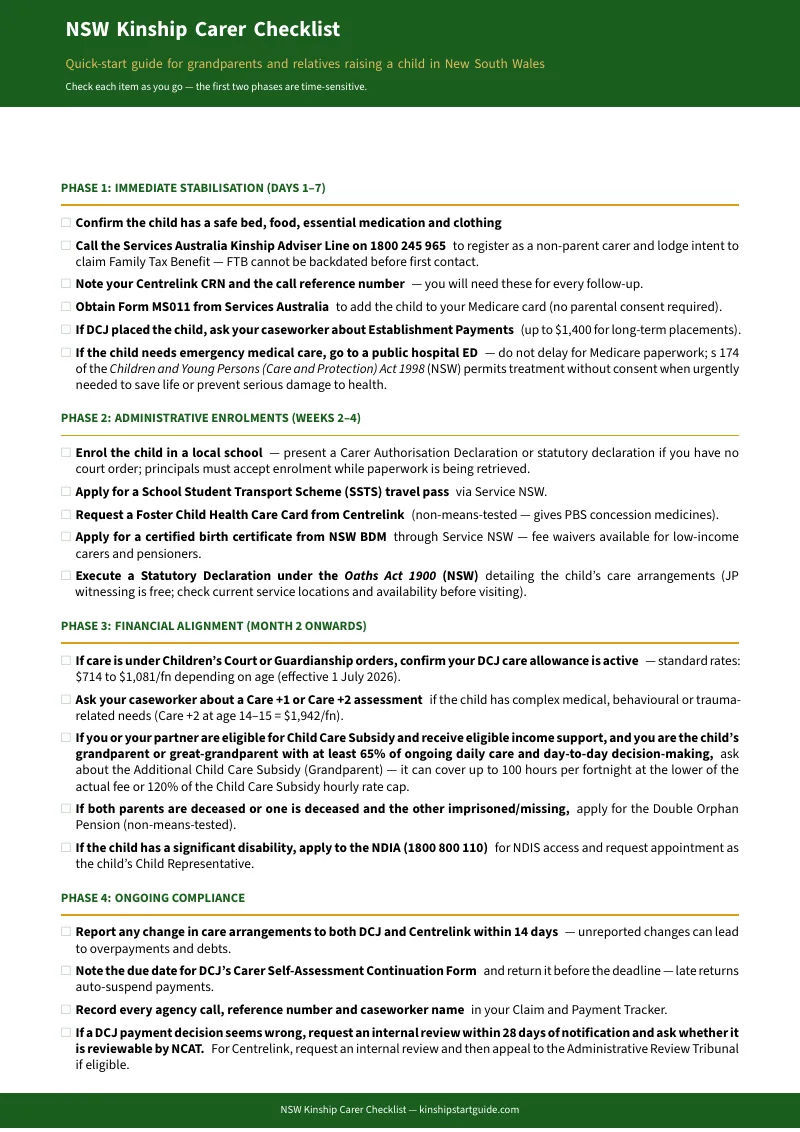
- Printable application checklist — 20 items covering every form, document, and deadline across Services Australia and DCJ
- NSW free-help directory — direct phone numbers and hours for Legal Aid NSW, LawAccess NSW (1300 888 529), the Welfare Rights Centre, My Forever Family NSW (1300 782 975), the Mirabel Foundation, the Aboriginal Legal Service, and COTA NSW
Who this is for
- Grandparents who just took on a grandchild. The child arrived suddenly. You're covering everything on a fixed pension. You need to know what the child qualifies for and where to apply — before you spend another fortnight paying for everything yourself.
- Relatives told "Centrelink can help" but not told how. You called the main Centrelink line and got transferred three times. You need to know exactly which line to call, what to say, and what to have ready so the claim gets processed instead of queued.
- Informal carers locked out of DCJ allowances. You read the DCJ website and concluded you're not eligible for anything because you don't have a caseworker or a care order. You need to know what you can claim through Centrelink while your arrangement is still informal.
- Aboriginal and Torres Strait Islander families navigating kinship care. You're caring for a child through cultural and community obligations and need guidance on entitlements without engaging DCJ casework or risking the child being placed with strangers.
- Helpers researching on someone's behalf. You're the adult child, niece, or family friend doing the online work because the grandparent raising the child is too exhausted to navigate government websites. You need a single document you can print and hand over.
Why not just use the free information?
The free information is good — and the guide links to all of it. Services Australia explains Family Tax Benefit. DCJ publishes care allowance rate tables. Legal Aid NSW explains parenting orders. Raising Children Network lists support services.
What none of them do is put Centrelink and DCJ side by side and show you how one system affects the other. Family Tax Benefit is on one website. DCJ care allowances are on another. The 35% care threshold is buried in a Centrelink policy page. Medicare card transfers are on a third. If you're a grandparent on the Age Pension raising a grandchild informally, trying to work out whether you should be calling Centrelink or DCJ first and what documents each one needs — good luck assembling the full picture from six separate government portals while you're also doing the school run and the after-school pickup.
The guide does that assembly. It puts every payment, every agency interaction, and every form into one sequence, organised by your care arrangement. If a Centrelink social worker or a Legal Aid solicitor is already coordinating everything for you, the free resources are probably enough. This guide is for people doing the navigation themselves.
Your purchase is protected
If the guide isn't useful to you, email [email protected] for a full refund, no time limit. No forms, no questions, no hassle.
The free checklist is available immediately with no purchase required — it lists the main payments, which agency administers each, the key form names, and the helpline contacts.
Get the full NSW Kinship Navigation System — the complete 44-page guide plus 8 printable worksheets, phone scripts, and tracking logs — and find out tonight what the child you're raising is entitled to.
Frequently Asked Questions
What if the rules change after I buy?
We update the guide when the rules change. Email us any time, even years later, and we'll send you the current edition free.