
You took in a child who needed you. Now Centrelink, the school and the GP all want paperwork you don't have.
One morning the house was quiet. Now there's a child who needs breakfast, a school uniform, a Medicare card that shows your name — and you're being passed from Centrelink to the ACT Education Directorate to a GP reception desk, hearing "we need proof" at every stop.
The ACT Government's carer handbook is written for statutory placements — children placed by the Community Services Directorate. If your arrangement is informal (most kinship carers), the handbook barely mentions you. Centrelink's website explains the rules but not the paperwork trail an informal carer needs to satisfy them. The school enrolment form asks for a parent's signature you can't provide. The GP wants written consent before treating a child who isn't legally yours.
Nobody hands you a single checklist that pulls it all together.
The ACT Kinship Carer Roadmap: one guide that maps Centrelink, school and medical paperwork into a single sequence
The ACT Kinship Carer Roadmap inside this guide is what makes it different from scattered government fact sheets. Instead of piecing together three agencies' requirements yourself, you follow one structured sequence — Centrelink evidence first, school enrolment second, medical consent third — because each step produces documents the next step needs.
The guide was built specifically for informal kinship carers in the Australian Capital Territory: grandparents, aunts, uncles and family friends raising a child outside the formal child-protection system. Every phone number, office address and form reference is ACT-specific and verified for 2026.
What's inside
- Centrelink claim preparation kit — the evidence checklist for Family Tax Benefit, Double Orphan Pension and Carer Allowance, with a worked example showing how to assemble your proof-of-care folder before you call the Grandparent Adviser Line
- ACT school enrolment walkthrough — what to bring when you don't have a parenting order, how to use a statutory declaration as alternative evidence, and the exact steps for updating the child's contact and pickup records
- Medical consent preparation folder — the authorisation paperwork your GP or Canberra Health Services clinic needs before treating a child in your care, including vaccinations and non-emergency visits
- Care type comparison matrix — a plain-English breakdown of informal, ordered and statutory care in the ACT, showing which payments and supports apply to each arrangement so you stop chasing benefits you're not eligible for
- Expense and receipt ledger — a categorised tracking sheet for clothing, medical, school and childcare costs, ready for tax time or a Centrelink review
- Claim progress log — a single place to record every call date, officer name, reference number and promised follow-up, so nothing falls through the cracks
- Care history timeline — a chronological template for documenting when the child arrived, parental contact, health appointments and school milestones, which strengthens every future application
- Verified ACT contact directory — the Grandparent Adviser Line, ACT Kinship Assessment Team, Cultural Services Team, Carers ACT, Child and Family Centres, Legal Aid ACT and emergency numbers, with opening hours and what each service can (and cannot) help with
Who this guide is for
- Grandparents in the ACT who have taken in a grandchild suddenly and need to know which payments the child can claim and how to apply
- Aunts, uncles, older siblings or family friends raising a relative's child informally — without a court order or CSD involvement
- Relatives who already have a parenting order but still need help navigating Centrelink and school paperwork
- Adult children or family members buying the guide on behalf of an older relative who is providing day-to-day care
Why not just use the free information?
The free information is good — and this guide links to every source. The problem is that the free information lives in three separate systems that don't talk to each other.
Services Australia explains Family Tax Benefit eligibility but not what evidence an informal ACT carer needs to prove primary care without a court order. The ACT Education Directorate's enrolment form lists the documents accepted, but it's buried in an FOI record most carers don't know exists. Your GP will tell you they need written consent, but not which format the clinic will actually accept.
The guide connects these systems into one document. You open it when the child arrives, follow it agency by agency, and arrive at each appointment with the right folder in your hand.
Important: what this guide does not do
This is an administrative organising guide, not a legal service. It does not give legal or custody advice, predict court outcomes, guarantee benefit approvals or replace professional counsel. If you are in a custody dispute, contact Legal Aid ACT on 1300 654 314. If a child is in immediate danger, call 000 or the ACT Child Protection Helpline on 1300 556 729.
A full refund, no time limit
If the guide doesn't help, email [email protected] for a full refund. No deadline, no questions.
Start with the free checklist or get the complete guide
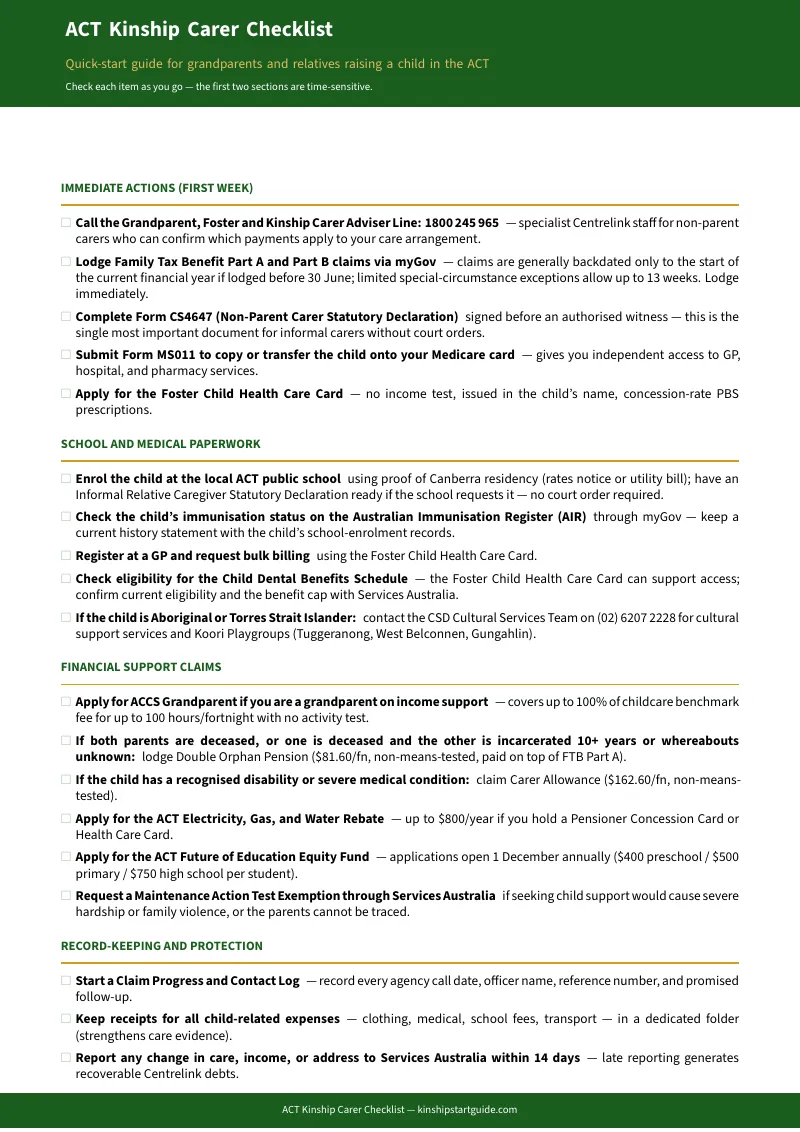
Download the free ACT Kinship Carer Checklist — a one-page summary of the payments, contacts and first steps — and see whether the approach works for you. When you're ready for the full tracking logs, evidence dossiers and worked examples, the complete guide is here for .
Frequently Asked Questions
What if the rules change after I buy?
We update the guide when the rules change. Email us any time, even years later, and we'll send you the current edition free.